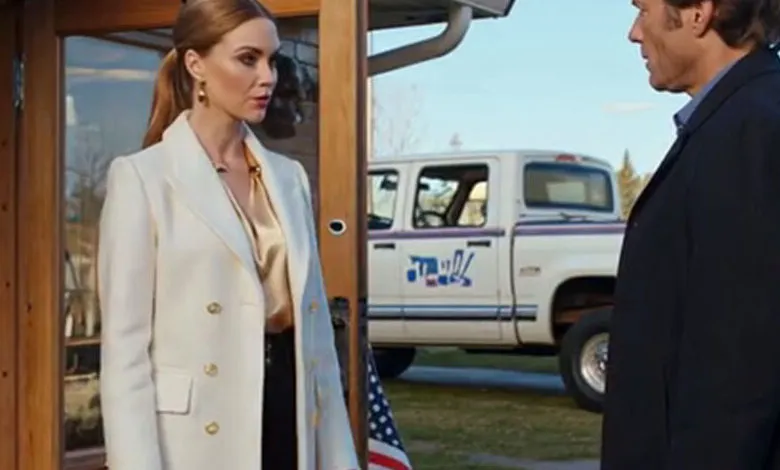
During Thanksgiving dinner, my husband looked at me and said, “You can’t do anything.” The whole family burst out laughing.
The cranberry sauce was still warm in my hands when my husband destroyed thirty-five years of marriage with seven words.
“Maggie always was a peso morto in this family.”
The ceramic serving bowl slipped from my fingers and hit the hardwood floor of our Overland Park dining room with a sound like a gunshot. Cranberry sauce splattered across the Persian rug Tom’s mother had given us for our tenth anniversary. The same rug I’d hand-cleaned twice a year for twenty-five years. The same rug where our children had taken their first steps, where we’d unwrapped Christmas presents and celebrated graduations and pretended we were happy.
The laughter started immediately.
My son David, thirty-two and too much like his father, snorted into his wineglass. My daughter Sarah covered her mouth, but I could see her shoulders shaking with suppressed giggles. Even my youngest, Michael, just turned twenty-seven, was grinning as he helped himself to more stuffing.
But it was my daughter-in-law Jennifer who laughed the loudest, throwing her head back like Tom had just delivered the punch line to the funniest joke in the world.
“Oh my God, Tom, that’s terrible,” she gasped between giggles. “But so accurate.”
I stood frozen beside the table I’d spent two days preparing, wearing the apron I’d embroidered with autumn leaves last September, surrounded by the people I’d devoted my entire adult life to serving.
The turkey I’d been basting since four in the morning sat golden and perfect in the center of the table. The homemade rolls were still warm from the oven. The sweet potato casserole with the marshmallow topping that took three hours to prepare properly steamed gently in my grandmother’s crystal dish. The dish I had promised myself I’d pass down to Sarah someday.
All of it ignored while my family laughed at the joke that was my life.
“Peso morto,” Tom repeated, savoring the Portuguese phrase he’d learned from his golf buddy Carlos. “Dead weight. That’s what you are, Maggie. Always have been. Dragging us down with your little hobbies and your crazy ideas.”
The “crazy idea” he was referring to had been mentioned exactly once, tentatively, hopefully, during the appetizer course.
A small bed-and-breakfast. Something I’d been dreaming about since the children left home three years ago. I’d even found a property—a Victorian house in Vermont that needed renovation but had good bones, character, potential.
“I think it could be wonderful,” I’d said quietly, passing the cheeseboard that had taken me an hour to arrange properly. “With the kids grown, we could start fresh. Travel. Meet new people. I could finally use my hospitality degree.”
The hospitality degree I’d earned at thirty-eight, taking night classes at Johnson County Community College while working part-time and still managing to have dinner on the table every evening by six thirty. The degree I’d never been able to use because someone needed to drive Sarah to soccer practice or David to debate team or Michael to guitar lessons—or Tom to the airport for another business trip where he’d come home exhausted and expectant, waiting for me to massage the tension from his shoulders and listen to his complaints about demanding clients.
“A bed-and-breakfast?” Tom had said, cutting into his perfectly prepared turkey with surgical precision. “With what money, Maggie? With what business experience? You’ve never run anything more complicated than a PTA fundraiser.”
“I ran the church charity auction for eight years,” I’d said, hating how defensive I sounded. “I organized the community food drive that raised over fifty thousand dollars. I managed the household budget through three recessions and still saved enough to—”
“That’s not the same as running a business,” David had interrupted, his voice carrying the same dismissive tone he’d inherited from his father. “Mom, you can’t just decide to become an entrepreneur at sixty-four. That’s not how the real world works.”
“Besides,” Sarah had added, not looking up from her phone where she was undoubtedly posting pictures of my carefully prepared meal to Instagram without credit, “you’d hate dealing with strangers all the time. You’re not exactly social.”
Not social.
The woman who’d hosted dinner parties for Tom’s colleagues for three decades. Who’d organized neighborhood block parties and school fundraisers and charity galas. Who’d been the perfect political wife during Tom’s brief stint as city councilman in suburban Kansas City—smiling and making small talk and remembering everyone’s names and their children’s accomplishments.
But I’d learned long ago that my family had a remarkable ability to forget my contributions the moment they were no longer convenient.
“It was just an idea,” I’d said finally, reaching for my wineglass and noticing how my hand trembled slightly. “Something to think about for the future.”
That’s when Tom had delivered his verdict.
“Peso morto. Dead weight.”
And they’d all laughed.
Now I stood in the ruins of my Thanksgiving dinner. Cranberry sauce seeping into the antique rug while my family continued their meal as if nothing had happened, as if they hadn’t just reduced thirty-five years of my life to a punch line.
“Maggie,” Tom said without looking up from his plate, “you going to clean that up, or just stand there all night?”
I looked at him—really looked at him—for what felt like the first time in years.
Tom Walsh, sixty-seven years old, silver-haired and still handsome in the way that middle-aged men with money and confidence often were. The same man who’d swept me off my feet at a college mixer at KU in 1985, who’d promised me adventures and partnership and a life full of possibilities.
Somewhere along the way, those promises had transformed into expectations.
I’d cook, clean, manage, organize, facilitate, and disappear. I’d become the invisible infrastructure that kept his life running smoothly. So invisible that my own family couldn’t imagine me as anything else.
“Actually, Tom,” I said, my voice surprisingly steady, “I think I’ll leave it.”
I untied my autumn leaf apron—the one I’d spent hours embroidering while watching Tom’s detective shows, the one that had seemed so festive this morning when I’d put on my good earrings and hoped for a pleasant family dinner—and dropped it on top of the cranberry mess.
“What the hell is wrong with you?” Tom’s voice carried the edge it got when his routine was disrupted. “This is your grandmother’s rug.”
“Yes. It is.” I walked to the coat closet and pulled out my navy wool coat, the one I’d bought three years ago but rarely wore because Tom said it made me look like I was trying too hard. “And now it’s yours to clean.”
“Mom?” Michael’s voice held the first note of uncertainty I’d heard from him all evening. “Where are you going?”
I paused at the front door, looking back at my family. They sat around my table under my grandmother’s chandelier, in the dining room I had decorated and maintained and loved, looking at me like I was a stranger who’d wandered into their lives by accident.
Maybe I was.
“I’m going to find out if I’m really dead weight,” I said, pulling on the leather gloves I’d received last Christmas from Sarah. Practical brown, forgettable gloves that matched exactly what she thought of me. “Or if you’ve all just forgotten what it feels like to carry yourselves.”
I walked out into the cold Kansas November evening, leaving the door open behind me so they could hear my car engine starting, could hear me backing out of the driveway of the house I’d called home for twenty-eight years.
I drove through our quiet Johnson County neighborhood where every house was lit with the warm glow of family dinners and football games—a Cowboys game murmuring from one window, the Macy’s parade replay drifting from another—where other women my age were probably loading dishwashers and wrapping leftovers and pretending their lives were exactly what they’d always dreamed they would be.
But I didn’t go back to our empty house with its perfectly coordinated Pottery Barn throw pillows and spotless kitchen and guest room that was always ready for visitors who rarely came.
Instead, I drove to the Marriott off I-35 on the edge of town, checked into a room with a view of the interstate and a Cracker Barrel sign glowing in the distance, and sat on the generic hotel bed with my phone in my hands.
The texts came from Tom at 11:30 p.m.
This is ridiculous. Come home.
At midnight.
Maggie, you’re embarrassing yourself.
At 12:30 a.m.
Fine. Sulk all you want, but you’re paying for that hotel room yourself.
I turned off my phone and opened my laptop.
The Victorian house in Vermont was still for sale. I’d been secretly checking the listing every week for two months, memorizing the photographs of the wraparound porch and the tower room that would make a perfect reading nook for guests.
But Vermont suddenly felt too close, too small, too much like the life I was trying to escape.
I opened a new browser window and typed six words that changed everything.
Remote property for sale, Alaska.
The photographs that filled my screen showed endless skies and untouched wilderness. Mountains that had never heard my family’s laughter at my expense. Lakes that reflected possibilities instead of limitations.
By three in the morning, I’d found it.
Fifty acres on the edge of nowhere, four hours from Anchorage, with a log cabin that needed work and a view that needed nothing but appreciation.
By four in the morning, I’d transferred the down payment from the savings account Tom didn’t know I had—the inheritance from my parents that I’d been carefully investing for fifteen years while he’d been making jokes about my grocery money.
By sunrise, I was driving north toward a life that would finally fit the woman I’d always been underneath the apron and the expectations and the weight of other people’s limitations.
Tom was right about one thing.
I had been carrying dead weight for thirty-five years.
But it hadn’t been me.
The real estate agent’s voice crackled through my cell phone like distant thunder. Professional concern barely masked what I suspected was genuine alarm.
“Mrs. Walsh, I have to ask—are you certain about this decision? Purchasing property sight unseen is always risky. But Alaska…”
Patricia Meadows paused, and I could hear papers shuffling in the background.
“Well, it’s not exactly retirement country for most people.”