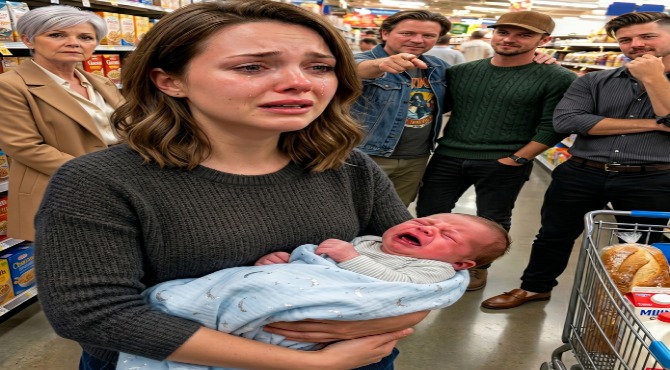
I thought it would be just another exhausting grocery run after a long day at work. Instead, a stranger’s panic attack in aisle six set off a chain of events that eventually reached all the way to my front door.
An Ordinary Grocery Run That Changed Everything
I’m 38 and divorced. That last part still doesn’t feel real.
I’m a mother of two teenagers, Mia and Jordan, and I write technical documentation for a cybersecurity firm. The pay is decent, but the work melts my brain some days.
Three years earlier, my husband decided he “needed to feel young again” and left me for a woman only three years older than our daughter. One day he was standing in the kitchen complaining about the Wi-Fi, and the next day he was gone.
What he left behind were two children, a mountain of bills, and a version of me who cried quietly in the shower so nobody would hear.
Eventually, I rebuilt my life. I moved into a smaller house, worked longer hours, and learned how to fix things with a combination of YouTube tutorials and stubbornness. Life slowly became functional again.
Not wonderful. Not glamorous. Just steady.
The afternoon everything changed, I had spent six straight hours editing a security guide. By the time I shut my laptop, my neck hurt, my eyes burned, and my brain felt completely overcooked.
On the way home, I stopped at the grocery store with one simple mission: buy pasta, sauce, and something green so I could pretend my family actually ate vegetables.
I parked, grabbed a basket, and walked inside on autopilot.
The store sounded exactly like every grocery store does—humming fluorescent lights, beeping checkout scanners, and terrible music floating through the speakers. I wandered into the canned goods aisle and stood staring at different tomato sauce brands as if there were somehow a wrong answer.
That was when I heard it.
A sharp, panicked sound behind me. Half sob, half gasp. The kind of sound that skips past logic and hits you directly in the chest.
I turned around.
A young woman—maybe in her early twenties—stood a few feet away clutching a tiny newborn wrapped in a blue blanket. Her face was paper white, her eyes wide with terror, and her breathing came in fast, shallow bursts like she couldn’t pull enough air into her lungs. Her knees kept buckling beneath her, as though her body wanted to collapse without warning her first.
The baby screamed with that raw newborn cry that makes every other sound in the room disappear.
And standing only a few feet away from her were three grown men laughing.
One tossed a bag of chips into his cart and sneered, “Control your brat.”
Another barely looked at her before muttering, “Some people shouldn’t have kids if they can’t even stand up.”
The third snorted and said, “Relax. She probably wants attention. Drama queens love an audience.”
Heat rushed into my face.
At first it wasn’t even anger. It was shame. Shame that adults could speak like that. Shame that nobody nearby said a single word. Shame that I was standing there frozen instead of helping.
Then the young woman’s hands began shaking so violently that the baby’s head jerked in her arms. Her knees buckled again.
For one horrible second, only one thought flashed through my mind:
She’s going to drop him.
I moved before I consciously decided to.
I rushed toward her and held out my arms.
“Hey,” I said quietly. “I’ve got him, okay? Let me help.”
She stared at me with wild eyes for a second. Then her shoulders sagged in surrender, and she let me take the baby.
The instant his weight left her arms, her legs gave out completely. She slid down against the shelf, her back hitting the metal with a dull thud.
I tucked the baby against my chest and cradled his head carefully. He was tiny, hot, furious, and screaming directly into my ear.
“Okay, little guy, I’ve got you,” I whispered.
Almost immediately, his cries softened from screams into hiccups, then into tiny whimpers as he pressed his face against my shoulder.
I looked over at the three men.
“Shame on you,” I snapped, louder than I intended. “She’s having a panic attack and you’re mocking her.”
They froze.
One muttered, “Whatever,” before pushing his cart away. The others followed him, suddenly fascinated by literally anything else in the store.
Then I turned back to the young mother.
“Okay,” I said gently. “We’re going to sit, all right?”
She was already sitting on the floor with her back against the shelves, trembling so hard her teeth clicked together. I wrapped one arm around her shoulders while still holding the baby in the other.
“It’s okay,” I murmured. “You’re okay. Just breathe with me. In through your nose, out through your mouth. I’m right here.”
“I couldn’t—” she gasped. “I couldn’t breathe. I thought I was going to drop him. Everything went blurry, and they were laughing and—”
“Hey,” I interrupted firmly but gently. “You didn’t drop him. You protected him. You came to get what he needs. That’s what a good mom does.”
The Ambulance Call
Using one thumb, I managed to dial 911 while still holding the baby.
“Hi,” I told the operator. “I’m at Lincoln Market on Fifth. There’s a young woman having a panic attack. She’s dizzy, shaking, says she can’t breathe. She’s got a newborn. We’re in aisle six. Can you send someone?”
After answering a few questions from the dispatcher, I hung up and looked back at the young woman.
“What’s your name?” I asked softly.
“K-Kayla,” she stammered.
“I’m Lena,” I said. “I have two kids. My daughter had panic attacks after my divorce. I know it feels like you’re dying, but you’re not. Your body is just freaking out. It will calm down. You’re safe.”
Tears immediately spilled down her cheeks.
“I’m so tired,” she sobbed. “He doesn’t sleep unless I hold him. I have no one. I was just trying to buy diapers, and they were laughing, and I thought—”
“Those guys?” I cut in. “They’re trash. You are not. You are doing this alone, and you are still here. That’s strength.”
People continued walking past us. Some stared openly. Others avoided looking altogether.
One older woman quietly stopped beside us, placed a bottle of water near Kayla, gently patted her shoulder, and walked away without saying a word.
The baby’s warm breathing pressed against my collarbone. My arm ached from holding him, but I didn’t move.
Within minutes, the paramedics arrived.
Two of them knelt beside Kayla and spoke in calm, steady voices.
“Hey there,” one paramedic said. “First panic attack?”
Kayla nodded while still trembling.
“Feels like you’re dying, right?” he said. “You’re not. We’ve got you.”
They checked her vitals and coached her through slower breathing. When they finally helped her stand, her legs still wobbled beneath her.
Only then did I hand the baby back.
Kayla wrapped herself around him tightly, resting her chin against the top of his head.
Before the paramedics wheeled her toward the front of the store, she reached for my hand.
“Thank you,” she whispered. “Thank you for not walking past me.”
My eyes burned.
“You’re welcome,” I said softly. “You’re not alone. Remember that.”
Then she disappeared through the front doors.
The grocery aisle looked exactly the same as before—rows of cans, shelves, and price tags—but my hands still trembled when I finally reached for the pasta sauce.
I finished shopping, drove home, cooked dinner, nagged my kids about homework, and answered a few late work emails. By bedtime, the entire experience already felt unreal, like one of those vivid scenes your brain creates that almost doesn’t seem real afterward.
I honestly thought that was the end of it.
I was wrong.
The Black SUV Outside My House
Three days later, I stepped outside carrying my travel mug and laptop bag, ready for another day of rewriting security documentation.
Then I froze.
A black SUV sat idling at the curb outside my house. The windows were tinted, the engine was running, and the vehicle looked far too expensive for my neighborhood.
For one confused second, I assumed they had the wrong address.
Then the back door opened.
A tall man wearing a dark jacket stepped out slowly with his hands clearly visible.
“Ma’am, please stop,” he called.
My heart immediately jumped.
“Yeah, no,” I answered from the porch. “Who are you, and what do you want?”
The man stopped several feet away and raised his palms calmly.
“My name is Daniel,” he said. “Please don’t be alarmed. We were asked to bring you to someone who’d like to speak with you.”
I laughed nervously.
“Bring me?” I repeated. “I have to go to work. And I’m not getting in a stranger’s car. That is how people end up on podcasts.”
“Your employer already approved your day off,” he replied calmly. “We requested it earlier this morning.”
“Sure you did,” I said skeptically. “My boss hates surprises. No way she did that without warning me.”
“Feel free to call,” he said.
So I did.
I called my manager and put the conversation on speaker.
“Hey, Lena!” she answered cheerfully. “Everything okay?”
“Did you approve a day off for me?” I asked while staring at Daniel.
“Oh yeah,” she said casually. “Got a very official request. You’re clear for the day. Don’t worry about anything here.”
I slowly lowered the phone while my stomach twisted uneasily.
“I’m still not going anywhere until I feel safe,” I told him.
Daniel nodded like he had expected that answer.
“You can take pictures,” he said. “Of me, my ID, the vehicle, the license plate. Send them to your family, your lawyer. Whatever you need.”
Oddly enough, that helped more than anything else he could have said.
I photographed his face, his identification badge, the SUV, the license plate, and even the VIN number. Then I texted all of it to my mother with a single message:
“IF I DISAPPEAR, THIS IS WHY.”
My phone immediately started buzzing with replies from her, but I shoved it into my pocket.
“Okay,” I finally said. “I’ll come. But if this goes sideways, my son is very good with computers and very dramatic.”
For the first time, Daniel almost smiled.
We drove for roughly thirty minutes.
The cracked sidewalks and dented mailboxes of my neighborhood slowly disappeared behind us. Then came neighborhoods with larger houses and neat lawns. Then came actual estates.
Finally, we turned onto a long driveway lined with carefully trimmed hedges and old trees.
At the very top stood a mansion.
Not simply a large house—an actual estate with stone pillars, enormous windows, and the kind of wealth that seemed unreal.
My stomach flipped.
“You sure this isn’t the fancy version of a kidnapping?” I muttered.
“I promise you’re safe,” Daniel replied.
Kayla’s Father
Daniel opened the SUV door for me, and I stepped out suddenly aware of my cheap flats and thrift-store jeans.
A man stood waiting at the top of the stone steps.
He looked to be in his late fifties or early sixties, wearing a gray suit without a tie. Silver touched the hair at his temples, and his calm eyes carried the look of someone who had experienced a great deal in life.
He walked toward me and extended his hand.
“Thank you for coming,” he said. “My name is Samuel. I’m Kayla’s father.”
Immediately, something inside me softened.
“Is she okay?” I blurted. “Is the baby okay?”
A small, warm smile crossed his face.
“Come inside,” he said. “Please.”
He led me through a massive entryway that looked as if it belonged in a magazine and into a bright sitting room filled with sunlight and high ceilings.
I sat nervously on the edge of a white sofa, gripping my travel mug like a shield.
Samuel settled into a chair across from me.
“You saved my daughter’s life,” he said quietly. “And my grandson’s.”
I shook my head immediately.
“I didn’t save anyone,” I answered. “She needed help. I was there.”
Samuel studied my face carefully before speaking again.
“Two years ago, Kayla left home,” he explained. “She felt stifled here. Wanted to prove she could build her own life. We didn’t stop her.”
He rubbed his forehead tiredly.
“She met a young man. Thought he was committed. When she found out she was pregnant, he left. She didn’t tell us. Pride is a heavy thing.”
He glanced upward for a moment before continuing.
“She worked. Struggled. Tried to do everything alone. Even when it became too much, she still didn’t call.”
Then he took a slow breath.
“Until that day. After her panic attack, she called us from the ambulance. First call in months.”
His voice softened noticeably.
“She told us about you. About how you took her baby so she wouldn’t drop him. How you sat on the floor with her. How you stayed until help arrived. She said you talked to her like she mattered.”
My throat tightened painfully.
“She asked if she could come home,” he continued. “We brought her and the baby here that night. They’ve been safe here ever since. Because of what you did.”
I swallowed hard.
“I just… did what I hope someone would do for my daughter,” I said quietly. “That’s all.”
Samuel smiled again, his eyes shining slightly.
“To you, maybe it was small,” he said. “To us, it changed everything.”
Then he straightened slightly in his chair.
“I’d like to thank you,” he said. “Properly. Tell me what you need. Anything.”
I shook my head immediately.
“Oh—no,” I protested. “Please. I didn’t come here for that. I don’t need anything. We’re okay.”
“I expected that,” he replied gently. “So I prepared two options.”
The Choice
Samuel nodded toward the window.
Outside sat a sleek silver SUV. Brand new. Polished. Intimidating.
“You can choose that vehicle,” he said, “or a check for $100,000.”
I stared at him.
Then at the SUV.
Then back at him again.
“I’m sorry,” I said slowly. “Did you say 100,000?”
“Yes.”
“I can’t take that,” I blurted out. “That’s… I just held her baby.”
“If you refuse,” he replied calmly, “I’ll send the car to your home, titled in your name. Humor an old man, Ms. Lena.”
Immediately, images flashed through my mind: my failing minivan, overdue bills, college emails from Mia’s school, and Jordan talking hopefully about technology programs that felt financially impossible.
“You said anything,” I said quietly. “If I have to choose… I’d take the money. My kids will be applying to college soon. That would help them more than a car.”
Samuel nodded with satisfaction.
“Then money it is,” he said. “We’ll arrange everything today.”
My hands trembled again.
“How did you even find me?” I asked. “I didn’t give her my last name.”
Samuel gave a faint, wry smile.
“I have connections,” he replied. “We traced the 911 call. You gave your name and address. The rest was simple.”
I winced slightly.
“That’s a little creepy,” I admitted.
“We meant no harm,” he assured me. “We simply refused to let your kindness vanish.”
At that moment, footsteps sounded behind me.
I turned.
Kayla stood quietly in the doorway.
She looked completely different from the woman I had met in the grocery store. Her clothes were clean, her hair brushed, and color had returned to her face. The baby rested peacefully in a gray sling against her chest.
She walked toward me slowly, her eyes shining.
“Hi,” she said softly.
“Hi,” I answered.
Stopping in front of me, she rested one hand protectively against the tiny curve of her son’s back.
“You didn’t let me fall,” she whispered. “Everything was spinning, and I couldn’t breathe, and those men were laughing, and I was sure I was going to drop him. Then you were just… there.”
My eyes burned once again.
“I’m so glad you’re okay,” I told her. “You and the baby.”
“His name is Eli,” she said.
I gently reached out and touched the tiny sock covering his foot.
“Hi, Eli,” I whispered.
He continued sleeping peacefully.
I still don’t know whether what I did truly counts as saving someone.
I only know this:
Sometimes you hold a stranger’s baby so she can breathe.
Sometimes you remind someone that she isn’t alone.