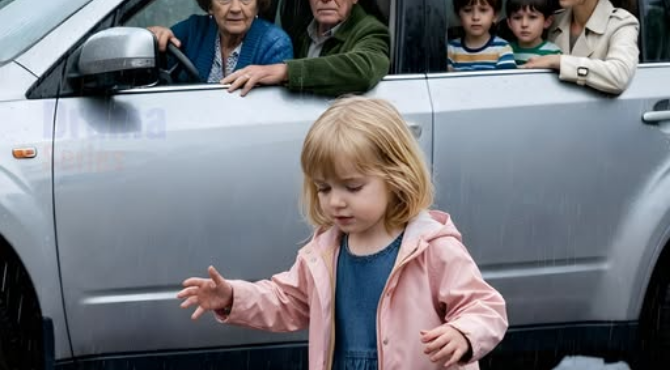
At pickup, my parents took my sister’s children and refused my daughter a ride. When she reached the car, my mother told her to walk home despite the heavy rain. My six-year-old begged, but they drove away, leaving her drenched and in tears.
The rain poured down in relentless, heavy sheets, turning the school parking lot into a blurred, gray reflection of the sky.
I was in the middle of a budget meeting—fluorescent lights humming overhead, spreadsheets glowing on the wall—when my phone suddenly vibrated across the conference table like something alive.
Mrs. Patterson’s name flashed on the screen.
Before I even answered, my stomach clenched.
“Are you Lily’s mom?” her voice came through, tight with urgency. “She’s outside the gate in this storm. She’s soaked through and crying. Your parents were supposed to pick her up… and they left.”
For a moment, everything around me dissolved into a haze. I grabbed my keys, muttered something about an emergency, and walked out without waiting for permission. The rain pounded against my windshield so fiercely it felt like the entire world was shouting at me. The wipers struggled to keep up. Every red light felt like a personal attack.
All I could see in my mind was Lily—six years old, far too small for this kind of fear—standing alone in weather even adults avoided.
When I pulled into the lot, I spotted her instantly. Mrs. Patterson stood beside her, holding an umbrella over her head, trying to shield her from the worst of the storm. Lily’s pink backpack sagged, heavy with water. Her blond hair clung to her cheeks. Her shoulders trembled, as if the cold had seeped deep into her bones.
The moment she saw my car, she ran.
“Mommy!” she cried, her voice breaking as her feet splashed through puddles.
I rushed out and scooped her into my arms, feeling the soaked weight of her clothes. She was shaking. I held her tightly—so tightly I could feel her heartbeat against mine.
“I’m here,” I whispered. “I’ve got you. You’re okay.”
She buried her face into my shoulder, sobbing. When she pulled back, her lashes were clumped together with tears and rain.
“Grandma and Grandpa… they left me,” she whispered.
Something inside my chest turned cold and sharp.
Mrs. Patterson apologized for calling, for “not knowing what the situation was,” but her voice barely reached me over the roaring in my ears. I thanked her anyway—because without her, Lily would have been alone out there.
Inside the car, I turned the heat up full blast and wrapped Lily in my coat. Her teeth chattered uncontrollably. I buckled her in carefully, brushing the rain from her forehead.
“Tell me what happened,” I said as gently as I could.
Lily sniffled. “They came like normal. Their silver car. I ran to it.”
Her voice trembled, but she kept going, as if she needed me to hear everything.
“I went to open the door… and Grandma didn’t open it. She rolled down the window just a little.”
My grip tightened on the steering wheel.
“What did she say, baby?”
Lily’s eyes filled again. “She said… ‘Walk home in the rain like a stray.’”
It hit me like a slap. Not because it was surprising—my family had always known how to wound—but because those words were aimed at my child. My six-year-old.
“And Grandpa?” I asked, already bracing myself.
“He leaned over and said, ‘We don’t have room for you.’”
Lily’s lower lip quivered.
“I told them it was raining. I told them it was far. I said, ‘Please, it’s pouring.’”
She wrapped her arms around herself, as if she could still feel the cold.
“And then Aunt Miranda was there,” she continued. “She looked at me like… like she didn’t care.”
That name ignited something dark inside me. Miranda—my sister, the center of gravity in our family. The one everything revolved around, no matter who got crushed in the process.
“She said her kids deserved the comfy ride,” Lily whispered. “And Bryce and Khloe were in the back. Dry. They just looked at me.”
My vision blurred with anger. I forced myself to stay calm—because Lily was watching me, searching my face to know if she was safe.
“So they drove away?” I asked quietly.
Lily nodded, tears spilling over. “I stood there and didn’t know what to do. I thought you would come, but… I didn’t know if you knew.”
My throat tightened painfully. I reached over and took her hand.
“You did nothing wrong,” I told her firmly. “Nothing. Not one thing. You hear me?”
She nodded, smaller this time.
The drive home felt like I was carrying a storm inside the car, not just outside it. I kept my voice steady for Lily, but my thoughts were racing—connecting pieces I had ignored for years.
This wasn’t a single act of cruelty. It was the undeniable proof of a long pattern.
My parents had always favored Miranda. She stayed close. She gave them grandchildren first. She lived the kind of life they could proudly talk about. I was the “responsible one”—the one who didn’t “need as much,” the one who could absorb whatever they gave.
And for years, I allowed it.
I helped because I believed that’s what family meant. I helped because I didn’t want Lily growing up thinking love had conditions. I helped because my parents were skilled at disguising wants as emergencies and obligations as “just this once.”
But leaving Lily in a storm? Telling her to walk home like she didn’t matter?
That wasn’t a mistake. That was a choice.
At home, I ran her a warm bath. I sat on the bathroom floor talking to her as steam filled the room and color slowly returned to her cheeks.
Afterward, I made her hot chocolate and wrapped her in a thick blanket until she looked like a tiny burrito. She curled up beside me on the couch, quiet and exhausted in a way that broke my heart.
“Do I have to see them again?” she asked softly.
“No,” I answered immediately. “Not if you don’t want to. You are allowed to feel safe.”
Her shoulders relaxed, like she’d been holding tension all day.
When she fell asleep, I carried her to bed and tucked her in. I stayed until her breathing evened out, until she fully settled into rest.
Then I went into my office, closed the door, and opened my laptop.
There was no drama in what I did next. I approached it like a surgeon.
Because that’s exactly what it was: I was cutting off the financial lifeline that had supported my parents and sister for years.
I opened my accounts and stared at the autopayments I had accepted as normal.
Mortgage support: nearly $3,000 a month.
Car payment: $800.
Health insurance: $600.
Utilities, HOA fees, even their country club membership—because my mother “needed” appearances.
And Miranda?
Private school tuition. A nicer car lease. Vacation expenses. Endless “emergencies” that never seemed to end.
I went through the statements, watching the numbers pile up into something grotesque.
Over four years, it totaled more than $370,000.
Money meant for Lily’s future. Money I could have invested in our life. Money earned through long hours and relentless pressure—while they treated me like a resource, not a daughter.
My hands were steady.
I canceled the mortgage autopay.
Canceled the car payment.
Removed myself from their insurance.
Stopped the tuition payments.
One by one, I shut everything down until the screen was clean.
Then I leaned back and stared at the silence I had created.
At 11 p.m., David found me there, the spreadsheet still open.
He leaned over, eyes widening. “I knew it was a lot,” he said quietly. “But… this?”
“I’ve been a fool,” I whispered.
He turned my chair toward him. “No,” he said firmly. “You’ve been generous to people who treated generosity like entitlement.”
That night, sleep came in fragments. Every time I closed my eyes, I saw Lily standing in the rain. I heard my mother’s words echoing.
The next morning, I took Lily to her favorite breakfast place before school. She ordered chocolate chip pancakes and talked about her friends, as if trying to return to normal.
In the parking lot, she looked up at me.
“Are Grandma and Grandpa mad at us?” she asked.
I crouched down to her level. “They made a bad choice,” I said carefully. “Sometimes adults make bad choices, and there are consequences. But you didn’t do anything wrong. Not ever.”
She blinked. “But… they left me.”
“I know,” I said, my voice steady as steel. “And that’s why I’m making sure it never happens again.”
She wrapped her arms around me. “I love you, Mommy.”
“I love you more than anything,” I replied.
Back in the car, before starting the engine, I sent one group text:
After what you did to Lily, every payment stops immediately. You are on your own. Do not contact me or my daughter again.
Then I turned off my phone.
When I turned it back on later, the messages flooded in—confused, then angry, then desperate.
My mother demanded to know why the mortgage bounced.
My father called me “dramatic.”
Miranda raged about her children “suffering.”
Not one message asked about Lily.
Not one asked if she was okay.
Not one apology.
Everything was about money, inconvenience, embarrassment.
That’s when something inside me went completely still—like a machine finally shutting down.
By noon, my father’s calls turned into threats about “family loyalty.” My mother accused me of “destroying the family.”Family
I looked at Lily, sitting on the living room rug, laughing as she built a tower.
Safe.
And I understood something clearly.
The family wasn’t destroyed by my boundaries.
It was destroyed the moment they decided my daughter didn’t deserve a seat in the car.
When my father called again, I answered—just once.
I let the silence stretch until he understood something had changed.
He began angrily, but I cut him off.
“You left my daughter in a storm,” I said, my voice cold and steady. “So don’t talk to me about what I owe you.”
There was a pause so complete I could hear his breathing.
And for the first time in my life—
he had nothing to say.