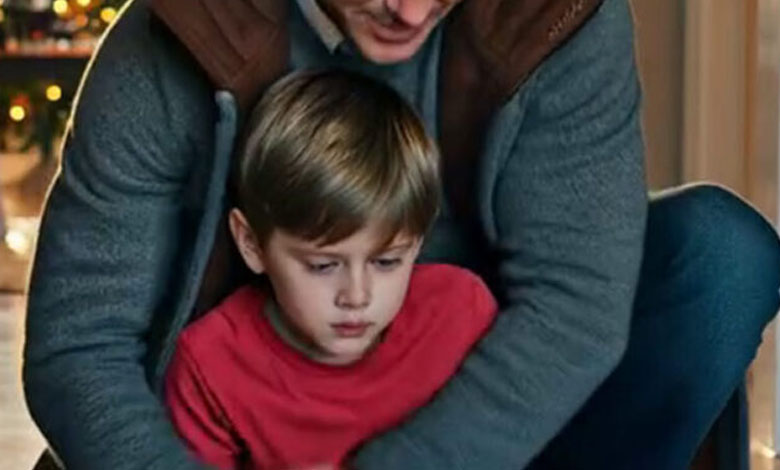
Part One – Cracks in the Holiday Cheer
The coffee in Frank O’Connell’s mug had gone cold an hour ago, but he barely noticed.
His office—a converted garage behind the small house he and his family rented in a modest Chicago neighborhood in the United States—was littered with transcripts, photographs, and half‑written scripts for his podcast series. At thirty‑eight, Frank had traded his job as an investigative journalist at the Chicago Tribune for running his own production company, Undercurrent Media.
The move had been Ashley’s idea three years earlier, back when she still looked at him like he’d hung the moon instead of like he was a burden she’d inherited.
His phone buzzed on the desk.
Another text from Ashley.
Running late. Mom needs help with the Christmas decorating. Can you get Todd from school?
Frank glanced at the wall calendar. December 20th. This would be the fourth time that week Christa Raymond had “needed help with something.”
He typed back:
Got him. See you tonight.
The afternoon sun cast long shadows across the suburban Chicago street as Frank pulled up in front of Meadowbrook Elementary. Kids poured out of the building, shouting and laughing, winter hats bobbing as they ran toward waiting SUVs.
Todd emerged alone.
Small for his seven years, he walked with his shoulders slightly hunched, his backpack nearly as big as he was. The sight made Frank’s chest tighten.
“Hey, buddy!” Frank reached over to pop open the passenger‑side door.
Todd climbed in, fumbling with his seat belt. “Hi, Dad.”
“How was school?”
“Fine.”
Frank had been conducting interviews for fifteen years. He knew evasion when he heard it.
“Just fine, huh? What did you do in art class? You had that snowman project, right?”
Todd’s jaw tightened, a gesture so similar to Frank’s own that it was like looking in a mirror.
“Mrs. Patterson said it was good,” Todd muttered.
“Can I see it?”
“I… left it there.” Todd stared hard out the window. “It’s for the classroom display.”
Frank knew his son was lying. He also knew that pushing now, trapped together in the car, wouldn’t help.
“Want to stop for hot chocolate?” he asked instead.
For the first time that day, Todd’s face brightened.
“Really?”
“Really. Just us. We can go to Bernie’s.”
Twenty minutes later, they sat in a corner booth at Bernie’s Diner, the kind of place in Chicago that still had vinyl seats, a jukebox in the corner, and served breakfast all day.
Todd wrapped both hands around his mug, letting the heat sink into his fingers. Marshmallows melted into white swirls across the top.
“Dad?” Todd’s voice was quiet.
“Yeah, buddy?”
“Are we going to Grandma Christa’s for Christmas?”
“That’s the plan,” Frank said. “Why?”
Todd shrugged, but his knuckles whitened around the mug.
“Just wondering.”
Frank leaned forward, elbows on the table.
“You can talk to me about anything, Todd. You know that, right?”
“I know,” Todd said, eyes fixed on his hot chocolate. “But…”
His sentence trailed off into the steam.
Frank’s phone buzzed on the table.
Ashley again.
Can you bring the good champagne when you come for dinner tomorrow? Mom’s making her special lamb.
He texted back:
Sure.
What he didn’t text was the thought that burned in the back of his mind.
When did your mother’s dinners become more important than your son?
The Raymond house sat in Kenilworth, one of the wealthiest suburbs on Chicago’s North Shore. The Georgian colonial—“historic,” as Christa never failed to mention—loomed at the end of a circular driveway lined with carefully trimmed hedges.
Frank pulled into the drive at 6:30 the next evening, Todd silent in the back seat.
“Remember,” Frank said, turning to look at his son before they went in, “you don’t have to pretend to be happy if you’re not. Just be yourself.”
Todd nodded but didn’t meet his eyes.
The front door opened before they reached it.
Bobby Raymond Mills, Ashley’s older sister, stood there wearing a cream cashmere sweater that probably cost more than Frank’s monthly podcast budget.
“There they are,” she sang out. “Come in, come in. You’re late.”
“We’re actually five minutes early,” Frank said evenly.
Bobby’s smile never wavered.
“Well, everyone else has been here for thirty minutes.” She looked down at Todd. “Your cousins are in the playroom, sweetie. Run along.”
Frank watched Todd trudge toward the back of the house, his small frame disappearing around the corner.
Bobby’s daughters, Madison, nine, and Harper, six, had already received more Christmas presents in the past week than Todd would get all year—if the glossy shopping bags Frank had seen Ashley hiding in their closet were any indication.
Before he could say anything, Christa swept into the foyer.
At sixty‑two, with diamonds at her throat catching the light from the chandelier, she carried herself with the chilly confidence of a general planning a campaign.
“You brought the Veuve Clicquot,” she said, taking the bottle from his hand. “How thoughtful. Though I must say, the Moët is really superior with lamb.”
“I’ll keep that in mind,” Frank said.
Harvey Raymond appeared behind his wife, a tall man with silver hair and the bearing of someone accustomed to deference. He’d made his fortune in commercial real estate and rarely let anyone forget it.
“Frank, good to see you,” Harvey said, clapping him on the shoulder. “Ashley’s in the kitchen with her sister.”
Dinner proceeded as these dinners always did.
Christa held court at the head of the long mahogany table, directing conversation like a conductor leading an orchestra. Harvey discussed business deals and market trends. Bobby talked about Madison’s acceptance into an exclusive summer program “for gifted students.” Renee Mills, Bobby’s husband, made safe jokes and laughed a little too loudly at Harvey’s stories.
Frank sat midway down the table, opposite Ashley. In the candlelight he studied his wife.
They’d met nine years earlier when he was covering a story about urban renewal in Chicago and she was volunteering at a community center on the South Side. She’d been passionate then, bright‑eyed, talking about making a difference.
Now she wore pearls that matched her mother’s and laughed at jokes that weren’t actually funny.
“Todd seems quiet tonight,” Christa observed, her tone suggesting this was somehow Frank’s fault. “Is he feeling well?”
“He’s fine,” Frank said. “Just tired from school.”
“Madison never gets tired from school,” Bobby put in. “Of course, she’s in the advanced program. Keeps her engaged.”
Frank felt Ashley’s hand clamp onto his knee under the table. A warning.
He took a long breath.
“Actually,” Christa continued, “I’ve been meaning to discuss Todd’s schooling with you both.”
Frank’s stomach tightened.
“Bobby found a wonderful tutor,” Christa went on. “Very exclusive. She works with gifted children, but I think Todd might benefit from some extra attention to help him catch up.”
“Catch up to what?” Frank asked.
“Well, to his peers, naturally. You want him to have every advantage. The Raymond family has standards, Frank. ‘Fine’ isn’t excellent.”
“Todd is seven years old,” Frank said.
“Exactly. These are formative years. We wouldn’t want him to fall behind.”
Ashley’s grip on his knee tightened, nails digging through his slacks.
When he looked at her, she gave a small shake of her head: Not here. Not now.
After dinner, Frank found Todd in the playroom.
Madison and Harper were building an elaborate castle with brand‑new Lego sets, the fancy kind in glossy boxes. Todd sat in the corner with a cardboard puzzle that looked like it had been gathering dust in a closet for years.
“Hey, buddy,” Frank said softly. “Ready to go home?”
Todd looked up, hope flickering in his eyes.
“Can we?”
“In a few minutes,” Frank said. “Mom wants to say goodbye to everyone.”
On his way back through the house, he passed the gallery wall of family photos.
Dozens of Madison and Harper: professional portraits, candid shots from vacations, school pictures in shiny frames.
Todd appeared in exactly three.
His newborn photo. One from his first Christmas. And last year’s obligatory family portrait. In that one, he stood at the edge of the frame, slightly out of focus.
Frank found Ashley in the kitchen, helping her mother wrap leftovers in perfectly labeled containers.
“We should get Todd home,” he said. “School tomorrow.”
“Oh, stay for coffee,” Christa insisted. “We barely got to talk. We’re family.”
“It’s already eight‑thirty,” Frank replied. “He needs sleep.”
Christa pursed her lips, but Ashley stepped in quickly.
“Maybe just one cup,” she said. “Then we’ll go.”
Frank’s jaw clenched. He said nothing.
Todd was asleep in the back seat before they’d left Kenilworth’s tree‑lined streets for the city.
Ashley stared out the passenger‑side window, her reflection ghosted over the dark winter sky.
“Your mother suggested a tutor for Todd,” Frank said finally.
“I know. She told me.”
“You don’t think that’s insulting?”
“I think she’s trying to help,” Ashley said. “She wants what’s best for her grandchildren.”
“All of them, or just Bobby’s?”
“That’s not fair.” Ashley turned to face him, eyes flashing in the dim glow of the dashboard. “Is it so terrible that my mother wants our son to excel?”
“Did you notice Todd playing with a puzzle that looked older than he is,” Frank asked, “while Madison and Harper built with Legos that probably cost three hundred dollars?”
“Maybe if you made more money,” Ashley snapped, “we could buy Todd those things ourselves instead of relying on my family’s generosity.”
The words hung heavy in the air.
Frank’s hands tightened around the steering wheel.
“I make enough,” he said quietly. “We’re not struggling. And I’ve never asked your family for a dime.”
“No,” Ashley shot back, “you just judge us for having it.”
Frank didn’t respond. What could he say?
That he’d watched his wife slowly transform into someone he barely recognized.
That every dinner at the Raymond house felt like watching Ashley choose her family over their son.
That he was starting to wonder if she’d married him as an act of rebellion she now regretted.
When they got home, Frank carried Todd upstairs and tucked him into bed.
His son’s room was modest but filled with things he actually used: chapter books they’d read together, drawings taped to the walls, a plastic globe they spun to pick imaginary adventures across the United States and beyond.