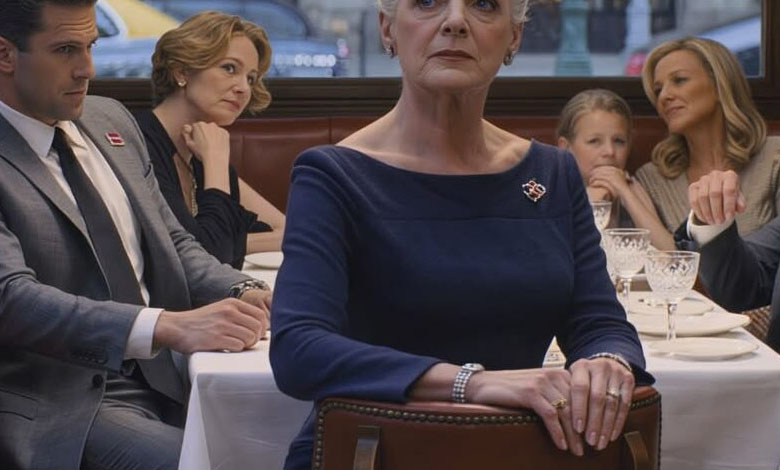
That night at dinner, a man called my son a broke loser.
I stayed silent.
But a mother’s silence is not weakness.
It is strategy.
My name is Florence Carter. I am 57 years old. This story began in an elegant steakhouse downtown, under the soft light of chandeliers and the murmur of other people’s conversations.
That night, my son Michael was formally introducing me to the parents of Emily, his fiancée. It was their engagement dinner. Everything was supposed to be perfect.
We arrived on time. I wore a navy-blue dress, discreet but elegant. Michael looked nervous in his gray suit—the same one he wore when he got promoted at the company where he works. He squeezed my hand before we walked in.
“Mom, everything is going to be okay,” he told me.
I nodded. But there was something in my chest—an unease I could not name at that moment.
Robert Miller was already waiting for us at the main table. He was a man in his 60s, heavyset, with gray hair slicked back and a gold watch that shined too brightly on his wrist. His wife, Linda, smiled nervously beside him. Emily looked radiant, holding Michael’s arm.
We sat down. We ordered wine. The first conversations were polite, trivial. We talked about the weather, the restaurant, the wedding. Robert ordered the most expensive steak on the menu without looking at the price. I ordered the baked fish. Michael ordered pasta.
Then, while we waited for the food, Robert leaned back in his chair. He took his glass of wine and looked at Michael with that kind of smile that never reaches the eyes.
“Tell me, Michael,” he said, “what do you do for work exactly?”
My son swallowed hard.
“I’m a financial analyst at the Sterling Group, Mr. Miller.”
Robert raised an eyebrow.
“Analyst,” he repeated, as if the word left a bad taste in his mouth. “And how much does an analyst make?”
There was an uncomfortable silence. Linda looked down. Emily squeezed Michael’s hand under the table.
“Enough to live well.”
“Dad,” Emily intervened softly, but Robert was not listening to her. His eyes were locked on my son.
“Because look, Michael,” he continued, pouring himself more wine, “my daughter has grown up with certain comforts—trips to Europe, private schools, piano lessons. I do not know if you understand the level she is accustomed to.”
Michael nodded, trying to keep his composure.
“I understand, sir, and that is why I work hard every day. I want to give her the best.”
Robert let out a short laugh, humorless.
“The best with an analyst’s salary.”
He set the glass on the table with a sharp thud.
“Let’s be honest, kid. That broke loser is not good enough for my daughter. She deserves someone on her level, not someone who can barely afford a decent restaurant.”
The entire restaurant seemed to stop. The words hung in the air like slow poison.
I felt the skin on my arms prickle. I felt the blood rise to my cheeks.
But I said nothing.
Not yet.
Michael lowered his head. I saw his hands trembling slightly on the table. I saw how he clenched his jaw to keep from crying. Emily turned pale.
“Dad, please,” she whispered.
But Robert was already standing up, throwing his napkin on the plate.
“I’m just telling the truth. And if my daughter is going to marry anyone, it has to be someone of value, not just anybody.”
I stood up slowly. I grabbed my purse. I looked at Michael and touched his shoulder.
“Let’s go, son.”
He nodded without looking at me. Emily tried to stop him, but Michael was already walking toward the exit. I followed him in silence, head held high, heartbroken.
Outside under the streetlights, Michael stopped and took a deep breath. His eyes were shining.
“I’m sorry, Mom,” he said with a broken voice. “I should have answered him. I should have.”
“No,” I interrupted, taking his face in my hands. “You did good. Dignity is not defended by shouting, Michael. It is defended by living.”
He nodded, although it still hurt.
We got into the car and drove home in silence.
But that night, while Michael slept, I stayed awake in the living room with a cup of coffee in my hands and my gaze lost in the window. I thought about that man, Robert Miller. I thought about his words, his arrogance, his poison.
And then I remembered something.
A name on a report. A face in a corporate photo.
Robert Miller worked at the Sterling Group.
At my company.
And he did not know it.
I smiled barely, without joy.
A mother’s silence is not weakness. It is patience.
And patience sometimes is the cruelest justice.
Sometimes we trust too much in people we should not.
“Have you ever been disappointed by someone you loved? Tell me your story in the comments. I want to read it.”
The days that followed that dinner were strange. Michael went out every morning to work with the same punctuality as always, but something in him had changed. He no longer whistled while making coffee. He no longer told me funny stories about his co-workers during breakfast. He ate in silence, looking at his plate as if searching for answers at the bottom of the bowl.
I did not talk much either. I did not know what to say.
How do you comfort a son when the words that hurt him do not come from an enemy, but from the father of the woman he loves?
One afternoon while I was making dinner, I heard the door open. Michael walked in looking exhausted, loosening his tie. He dropped onto the sofa and closed his eyes.
“How was your day, son?” I asked from the kitchen.
“Same as always, Mom,” he answered without opening his eyes.
That was a lie.
I knew that tone. It was the tone of someone carrying a weight they cannot name.
I sat beside him and offered him a cup of chamomile tea, the same one I made him when he was a child and could not sleep.
“Thanks,” he murmured, taking the cup in his hands.
“Have you talked to Emily?” I asked gently.
He nodded.
“Yes, every day.”
“And her?”
“She is very ashamed of what happened. She has apologized a thousand times. She says her dad is not normally like that, that he was stressed about work, that…”
“That she seeks to justify the unjustifiable,” I interrupted calmly.
Michael looked at me.
“I do not want this to ruin us, Mom. I love Emily and she loves me. Her father… well, her father is another story.”
I nodded. I was not going to argue with him. It was not the moment.
But in my chest, there was a certainty growing every day. Robert Miller did not know the woman whose son he had humiliated.
That night, after Michael went to sleep, I turned on my computer and opened the human resources archive of the Sterling Group. I typed the name Robert Miller.
There he was.
Operations manager. Twenty-three years in the company. Considerable salary. Clean record. No reported incidents. An exemplary employee according to the numbers.
But numbers do not tell the whole story.
Do they?
I closed the laptop and stared at the dark screen, seeing my own reflection in the black glass.
I remembered how I came to own the Sterling Group. It had not been easy. It had not been fast. But it had been fair.
I let my mind travel years back to when it all began.
I was 25 when I met John—Michael’s father. He was a hard-working man, honest, with the calloused hands of someone who does not fear effort. We got married in a simple ceremony with flowers from my mother’s garden and a dress she sewed herself.
John worked at a small logistics company. I was an administrative assistant at a government office back then. We earned little, but we were happy. We rented a two-bedroom apartment in a quiet neighborhood.
We ate dinner together every night.
When Michael was born, the world became smaller and bigger at the same time. Smaller because my entire universe fit into that baby crying in my arms. Bigger because suddenly I understood the dimension of love a mother can feel.
John was a present father. He changed diapers. He rocked him to sleep. He sang made-up songs that had neither rhythm nor sense.
Michael laughed anyway.
But life sometimes does not ask if you are ready.
Michael was six when John died.
It was a traffic accident. A truck that did not brake in time. A curve calculated wrong. A second that changed everything.