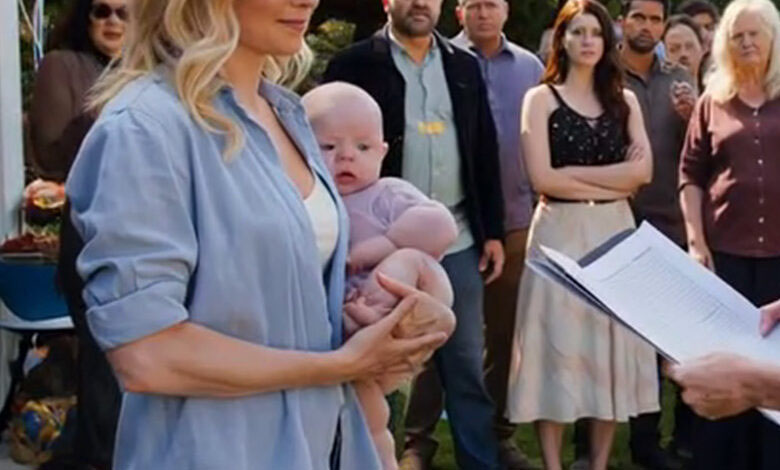
After my husband’s funeral, I went to my sister’s son’s first birthday party. And she announced,
“My son is your husband’s child. So, as inheritance, I’ll take half of your $800,000 house.”
She even showed me his will. I said,
“Oh, I see,”
and tried to hold back my laughter. Because my husband—my name is Bridget—and at 34 years old, I never expected to be a widow.
Three months ago, I lost Adam, my husband of 11 years, to a sudden aneurysm. Just days after his funeral, I dragged myself to my nephew Lucas’s first birthday party, where my sister Cassandra dropped a bomb. She announced that Lucas was actually Adam’s son, showing everyone a will, claiming half of my $800,000 house. What she did not know was why I could barely hold back my laughter. If you are watching this from somewhere where family drama hits close to home, take a moment to like and subscribe. Trust me, you will want to hear how I handled what came next.
Adam and I met 12 years ago at a charity auction benefiting children with cancer. I was volunteering, helping organize the silent auction items, when he outbid everyone else for a painting I had been admiring all night. It was a watercolor of the Boston skyline at sunset—vibrant oranges and purples bleeding into the harbor. After winning, he walked straight over to me and handed it over.
“I noticed you looking at this all night,” he said, with a smile that made his blue eyes crinkle at the corners. “I think it belongs with you.”
That was Adam. Thoughtful, observant, and generous to a fault. I fell hard and fast. We went on our first date the next evening, and it felt like we had known each other our entire lives. He was a corporate attorney—brilliant, but humble—the kind of man who remembered the names of wait staff and asked genuine questions about their lives.
Eight months after we met, he proposed on the harbor, with the actual skyline mirroring the painting that brought us together. We bought our Victorian home in Beacon Hill shortly after our first anniversary. It was a stretch financially at $800,000, but Adam had just made partner at his firm, and I was building a solid reputation as an interior designer. The house needed work, but it had good bones—high ceilings and a small garden out back where I envisioned future children playing.
Those children never came. Not for lack of trying. For years, we charted and planned and hoped. Then came the doctors, the tests, the procedures—four rounds of IVF that drained our savings and our spirits. I still remember the last failed attempt, the quiet drive home from the clinic, Adam reaching across the console to hold my hand, neither of us speaking because we both knew that was the end of that road.
“We can still have a beautiful life,” Adam said that night as we sat on our porch swing. “You and me. That is enough.”
And he meant it. We slowly rebuilt our dreams. We traveled. We poured ourselves into our careers. We renovated the house room by room until it was the showcase home I had always imagined. Adam supported my business when I decided to launch my own interior design firm. Our life was full, if different than what we had first planned.
My younger sister, Cassandra, was always in the periphery of our happiness. Four years younger than me—30—she had always been the wild child of the family. While I was studying design and building a business, she was bouncing between jobs and relationships. Our parents constantly worried about her, which translated to them making excuses for her behavior and bailing her out of financial troubles repeatedly.
Cassandra and I had a complicated relationship from childhood. She was undeniably beautiful, with the kind of effortless charm that drew people to her, but there was always an undercurrent of competition from her side. If I achieved something, she needed to one-up me. When I started dating Adam, she suddenly became interested in law students. When we bought our house, she complained for months about her apartment, fishing for our parents to help her upgrade. It was exhausting, but Adam encouraged me to maintain the relationship.
“She is your only sister,” he would remind me. “Family is important.”
Two years ago, Cassandra started dating Tyler, a bartender she met while out with friends. He was handsome in a rugged way, with tattoos covering his arms and a motorcycle that our parents disapproved of. Their relationship seemed volatile from the outside—dramatic breakups and passionate reconciliations.
Then came the pregnancy announcement at Thanksgiving dinner the year before Adam died. It was unexpected, to say the least. I was living in the shadow of societal expectations. Yet there she was, announcing her pregnancy with theatrical tears and declarations about the miracle of life. I felt the familiar sting of jealousy. After all our struggles, all our heartbreak, Cassandra had accidentally achieved what we had desperately wanted. But I pushed those feelings down. I was genuinely happy for her, and I was determined to be the best aunt possible to her child.
Lucas was born a healthy 8 lb 4 oz. I was at the hospital with flowers and a handmade blanket I had spent months knitting. Cassandra seemed overwhelmed by motherhood from the start, often calling me in tears about Lucas’s colic or her exhaustion. I stepped in as much as I could, sometimes watching Lucas overnight so she could sleep.
Adam was less involved with Lucas than I was. In retrospect, I thought it was because of our own infertility struggles—that it might be painful for him to bond with a baby that was not ours. He was always kind when Cassandra brought Lucas over, but he maintained a certain distance that I never questioned at the time.
Then came that terrible Tuesday morning. Adam complained of a headache before leaving for work. I suggested he stay home, but he had an important client meeting. Just a migraine, he insisted, kissing me goodbye.
“I will call you after the meeting.”
That call never came. Instead, I got one from the hospital. By the time I arrived, he was already gone. Brain aneurysm, they said. Nothing could have been done. He was 36 years old.
The next days passed in a blur of arrangements and grief. Cassandra was strangely absent during most of it, sending text messages claiming Lucas was sick or she could not find a babysitter. When she did appear at the funeral, she stayed briefly, keeping to herself and leaving before the reception. I was too numb with grief to think much of it at the time.
One week after we laid Adam to rest, Lucas’s first birthday arrived. The last thing I wanted to do was attend a child’s birthday party, but family obligations pulled at me.
“Adam would want you to go,” my mother insisted during one of her daily check-in calls. “He always said family comes first.”
So I found myself driving to Cassandra’s small rental house in a less desirable part of town. A wrapped gift sat on the passenger seat, and dark circles under my eyes that no amount of concealer could hide. I had barely slept since Adam died, spending nights staring at his empty side of the bed, reaching for a warmth that was no longer there. I parked behind a line of cars and took several deep breaths before grabbing the gift and heading inside.
No one should have to fake happiness so soon after losing their husband, I thought, but I plastered on a smile and knocked on the door. Cassandra’s friend Jenna opened it, her eyes widening slightly at the sight of me.
“Oh, Bridget, you made it,” she said, her voice oddly strained.
She glanced over her shoulder before stepping aside.
“Come in. Everyone is in the backyard.”
The small house was decorated with blue balloons and streamers. A banner reading Happy First Birthday, Lucas stretched across the living room wall. I noticed a group of people I did not recognize clustered in the kitchen, whispering. They fell silent as I passed, their eyes following me.
In the backyard, more guests stood in small groups, plastic cups in hand. I spotted my parents sitting awkwardly at a picnic table, looking uncomfortable. My father stood when he saw me, relief washing over his face.
“Bridget,” he said, embracing me. “We were not sure you would come.”
“Of course I came,” I replied, setting the gift on the designated table. “Where is the birthday boy?”
“With Cassandra,” my mother said, not quite meeting my eyes. “They should be out soon for the cake.”
I mingled awkwardly, accepting condolences and deflecting questions about how I was holding up. Everyone seemed on edge—conversations stopping abruptly when I approached. I chalked it up to people not knowing how to act around a newly minted widow.
After thirty uncomfortable minutes, Cassandra emerged from the house carrying Lucas on her hip. She was wearing a new dress I had never seen before, her hair freshly highlighted. Lucas looked adorable in a little button-up shirt and bow tie, his chubby legs kicking with excitement at all the attention. Cassandra barely acknowledged me as she placed Lucas in his high chair. She seemed energized—almost giddy—moving around the yard with an unusual confidence.
Then she tapped a spoon against her cup, calling for everyone’s attention.
“Thank you all for coming to celebrate Lucas’s special day,” she began, her voice carrying across the yard. “This past year has been full of surprises and challenges, as many of you know.”
Guests exchanged glances. My mother suddenly became very interested in her shoes.
“I have been keeping a secret,” Cassandra continued, placing a hand on Lucas’s head, “one that I can no longer hide, especially after recent events.”
A chill ran down my spine. Something was very wrong.
“Lucas is not Tyler’s son,” she announced, her eyes finding mine across the yard. “He is Adam’s.”
The world seemed to stop. I heard gasps around me, felt my father stiffen beside me, but it was all background noise to the rushing in my ears.
“Bridget’s husband and I had a brief affair two years ago,” Cassandra continued, her voice steady and rehearsed. “It was a mistake, a moment of weakness for both of us. We never meant to hurt anyone, but these things happen.”
I stood frozen, unable to process what I was hearing. My sister was claiming she had slept with my husband. That her son—the nephew I had lovingly cared for—was actually Adam’s child. It was so absurd that I almost laughed out loud.
Cassandra wasn’t finished. She reached into her purse and pulled out a folded document.
“Adam knew the truth about Lucas. Before he died, he updated his will,” she said, holding up the paper. “He wanted his son to be provided for. This will states that half of the house Adam and Bridget owned should go to Lucas as his biological child.”
Every eye in the yard turned to me. I could see the pity, the morbid curiosity, the discomfort. My parents looked stricken, my father half standing as if unsure whether to intervene.
And then, to everyone’s surprise—including my own—I felt a smile tugging at my lips. Not a happy smile, but the kind that comes when something is so outrageously false it becomes almost comical. I pressed my lips together, trying to contain the inappropriate laughter bubbling up inside me.
“Oh, I see,” I said finally, my voice calm and even.
I took a sip of water to buy time, to push down the urge to laugh in my sister’s face.
“May I see this will, Cassandra?”
Her confident expression faltered slightly. She clearly had not expected this reaction. Slowly, she walked over and handed me the document—a typed page with what appeared to be Adam’s signature at the bottom.
I scanned it quickly, noting inconsistencies immediately. The formal language was all wrong, nothing like the legal documents I had seen Adam bring home. And the signature, while similar to Adam’s, was clearly forged. The connecting stroke between the A and D was wrong. The final flourish too pronounced.
I carefully folded the paper and handed it back to her.
“Thank you for sharing this with me.”
Then I picked up my purse.
“I think I need to go now.”
“That is it?” Cassandra asked, confusion evident in her voice. “You are not going to say anything else?”
“Not right now,” I replied calmly. “This is Lucas’s day. We can discuss this privately later.”
I said goodbye to my shell-shocked parents, promising to call them soon. As I walked to my car, I could hear the murmurs behind me. The party atmosphere completely shattered.
Once inside my car, safely out of view, I finally let out the laugh that had been threatening to escape. It started small, then grew until tears were streaming down my face—not tears of joy, but a strange mix of grief, anger, and incredulous disbelief at my sister’s audacity.
Because there was something Cassandra did not know. Something Adam and I had never shared with anyone. Something that made her elaborate lie not just hurtful, but impossible.
The truth about Adam and Cassandra began three years ago, long before Lucas was even conceived. We had invited my sister over for dinner to celebrate her new job at a marketing firm—her longest employment to date. Adam had prepared his famous lasagna, and we had opened a good bottle of wine. It was a pleasant evening until I excused myself to take a work call from a client having a design emergency. The call took longer than expected—nearly twenty minutes of talking a wealthy client through hanging artwork.
When I returned to the dining room, the atmosphere had changed. Adam looked uncomfortable, and Cassandra was sitting much closer to him than when I had left, her hand on his arm, laughing at something I had not heard. I thought nothing of it at the time. Cassandra had always been affectionate and the wine had been flowing freely.
But later that night, as we were getting ready for bed, Adam seemed troubled.
“There is something I need to tell you,” he said, sitting on the edge of our bed. “And I do not want it to cause problems between you and your sister, but I also do not want to keep secrets from you.”
He explained that while I was on the phone, Cassandra had made a pass at him. Nothing dramatic—just inappropriate comments about how lucky I was to have him, followed by a suggestion that he deserved someone who could truly appreciate him. When he rebuffed her, she laughed it off as a joke, saying I was too sensitive if he thought she was serious.
I was hurt, but not entirely surprised. Cassandra had always pushed boundaries. We decided to let it go as an isolated incident, something caused by wine and her usual competitive nature.
But it was not isolated.
Over the next few months, Cassandra found ways to touch Adam whenever I was not looking. She sent text messages that walked the line between friendly and flirtatious. She once showed up at his office uninvited, asking him to lunch. Each time, Adam gently but firmly maintained boundaries, and he told me immediately afterward.
After the office incident, we confronted my parents about Cassandra’s behavior. It did not go well. They suggested Adam was misinterpreting friendly gestures and that Cassandra just looked up to him as a brother. My mother even suggested—with good intentions but terrible judgment—that perhaps Adam was feeling flattered by the attention and exaggerating the situation.
That night, Adam and I made a decision. We would create distance from Cassandra without causing a family rift. We declined invitations that included her. We made sure we were never alone with her. And Adam blocked her number on his phone after she sent a particularly suggestive late-night message.
Then came the medical issue that changed everything. Adam had been experiencing pain for weeks before finally seeing a urologist. The diagnosis was a varicocele—an enlargement of veins within the scrotum requiring surgery. The procedure went well, but there was a complication. The doctor recommended a vasectomy during the same surgery due to the extensive nature of the varicocele and potential for recurrence.
It was a difficult decision, especially given our past fertility struggles, but we agreed it was the right choice for Adam’s health.
The vasectomy was performed two years before Lucas was conceived.
We kept this medical information private. Even our parents did not know. After years of invasive questions about our childless status, we had learned to protect our privacy around reproductive issues. The only people who knew were Adam, myself, and Adam’s doctors.
After the surgery, as Adam was recovering, he made a prediction that seemed paranoid at the time.
“Cassandra is not done,” he said, sitting in our garden with an ice pack discreetly positioned. “I have a feeling she might try something more drastic one day.”
I laughed it off, but Adam was serious. The next week, he scheduled an appointment with our family attorney, James Wilson. I went with him, listening as Adam detailed Cassandra’s behavior and his recent medical procedure. James recommended documenting everything—the unwanted advances, the medical records confirming the vasectomy, even text messages and emails from Cassandra.
“You never know what might become relevant,” James advised. “Better to have documentation and never need it than wish you had it later.”
We followed his advice, creating a file of everything related to the situation. Adam also updated his will properly through official channels, making sure everything would come to me in the event of his death. James kept copies of all documents, and we placed the originals in a safety deposit box at our bank.
“Just in case,” Adam had said when we locked the box, “though I plan to be around to deal with any of Cassandra’s drama for at least another fifty years.”
The morning after Lucas’s birthday party, I drove straight to the bank. The manager, who had known Adam and me for years, expressed condolences as he led me to the vault. I sat alone in the small viewing room and opened the box Adam and I had filled with what he jokingly called our disaster preparation kit.
Inside was exactly what I needed: Adam’s legitimate will—notarized and properly executed—leaving everything to me. Medical records detailing his vasectomy two years before Lucas’s conception, making it biologically impossible for him to be the father. A journal Adam had kept documenting every inappropriate interaction with Cassandra, including dates, times, and exact quotes. Printed copies of text messages she had sent him. A letter from our attorney confirming that he had witnessed Adam’s legitimate will and was available to verify its authenticity.
And at the bottom of the box was a sealed envelope with my name written in Adam’s familiar handwriting.
With trembling fingers, I opened it and began to read.
“My dearest Bridget, if you are reading this, something has happened to me, and you have needed to access these documents. I hope it is many years from now when we are old and gray and Cassandra’s antics are nothing but a distant memory we laugh about. But if not—if the worst has happened and she has tried to hurt you in my absence—please know that I tried to prepare for every possibility. Use these documents to protect yourself. I know how much you value family, how loyal you are to those you love. But you deserve to be protected from those who would take advantage of that beautiful heart of yours. I love you beyond words, beyond time. Whatever happens, know that. Adam.”