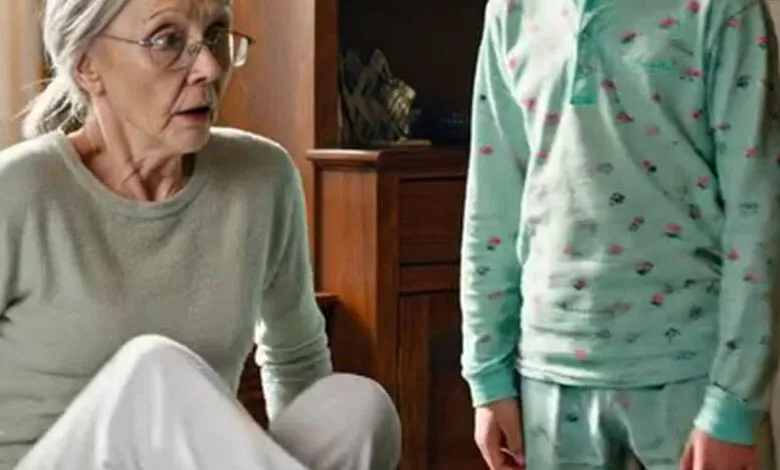
The smell of smoke still clung to my clothes three days after the fire. I stood in what used to be my living room, staring at the charred skeleton of my piano, the instrument where I’d taught my son Michael to play “Clair de Lune” when he was seven.
The fire marshal said it started in the kitchen. Probably faulty wiring in the old house. Sixty-three years I’d lived in that colonial on Maple Street in Rochester, New York. Sixty-three years. And now it was ash.
“Mom, you can’t stay in a hotel forever,” Michael had said on the phone that morning, his voice tight with concern. “Caroline and I insist. We have plenty of room. You’ll stay with us until we figure things out.”
I didn’t want to be a burden. I’d raised Michael to be independent, self-sufficient, but my savings were modest, and the insurance company was dragging their feet about the claim. The adjuster had visited twice, asking strange questions about whether I’d been having financial difficulties. The insinuation stung, but I kept my composure. At sixty-eight, I’d learned that patience and politeness opened more doors than anger ever could.
So, I’d agreed.
Just temporarily, I told myself, as Michael loaded my three salvaged suitcases into his Mercedes, just until the insurance came through.
Their house in Brighton was impressive, the kind of place you see in glossy suburban magazines. A sprawling Victorian with a circular driveway, a neatly edged lawn, and perfectly manicured hedges. An American flag fluttered from a white porch column, and the neighbors’ mailboxes were all identical, lined up like soldiers.Caroline met us at the door, framed by the stained-glass transom. Her smile didn’t quite reach her eyes.
My daughter-in-law was beautiful in that calculated way—highlighted hair always perfect, clothes expensive but understated. The kind of woman who made you feel slightly rumpled in comparison.
“Christine, welcome,” she said, air-kissing both my cheeks. “We’ve prepared the guest room. It’s not much, but it’ll do for now.”
The guest room was on the third floor, a converted attic space with sloped ceilings and a single dormer window that looked out over the quiet, tree-lined street. It was clean but sparse, furnished with castoffs: a sagging double bed, a dresser with a sticky drawer, a reading lamp that flickered when I switched it on.
I noticed immediately there was no lock on the door.
“Dinner’s at six sharp,” Caroline announced. “We keep a schedule in this house. It’s important for the children.”
I hadn’t seen my grandson Tyler in months. At thirteen, he’d grown tall and quiet, spending dinner pushing food around his plate while his parents discussed Michael’s law practice and Caroline’s charity work—a fundraiser for the local arts council, a gala at the country club, a board meeting at the hospital foundation.
My granddaughter, Jane, only nine, chattered about her dance recital, but Caroline cut her off.
“Not at the table, Jane. We’ve discussed this.”
The child’s face fell, and something protective flared in my chest. I opened my mouth to say Jane’s excitement was perfectly natural. But Caroline’s sharp glance silenced me.
This wasn’t my house. These weren’t my rules.
That night, exhausted from the move and the weight of loss, I fell into a deep sleep.
I woke to breathing.
Not my own. Someone else’s. Close and deliberate.
My eyes snapped open. In the darkness, a figure stood beside my bed, small and motionless. My heart hammered as I fumbled for the lamp.
In its weak glow, I saw Tyler. His face was pale, his eyes wide with something I couldn’t name. Fear? Warning?
“Tyler? What’s wrong, sweetheart?” I whispered.
“Grandma,” he whispered back, his voice barely audible. “You need to find another place to stay.”
The words hit me like cold water.
“What? Why would you—”
“Shh.” He glanced toward the door, then back at me. “I can’t explain now, but you’re not safe here. Please, you have to believe me.”
My mouth went dry. This was my grandson—a boy I’d babysat, whose scraped knees I’d bandaged, who’d cried in my arms when his goldfish died. He wasn’t prone to dramatics or lies.
“Tyler, you’re scaring me. What’s going on?” I asked.
He moved toward the door, then turned back.
“Follow me. I’ll show you something, but be quiet. Really quiet.”
Every instinct told me this was wrong, that I should wake Michael, turn on every light in the house, demand an explanation. But something in Tyler’s expression—desperate, urgent, terrified—made me swing my legs out of bed.
I pulled on my robe and slippers and followed him into the dark hallway.
The house was silent except for the ticking of the grandfather clock downstairs. Tyler moved like a ghost, avoiding the creaky floorboards with practiced ease. He led me down to the second floor, past the master bedroom where I could hear Michael’s soft snoring, past Jane’s room with its nightlight casting a pink glow.
We stopped at a door I’d assumed was a linen closet.
Tyler produced a key from his pajama pocket. Where had he gotten that? He unlocked the door.
Inside wasn’t a closet, but a small office dominated by a desk covered in file folders and a laptop. An expensive ergonomic chair sat behind it, and legal pads were stacked neatly on one side.
“This is Mom’s private office,” Tyler whispered. “No one’s allowed in here, not even Dad.”
“Tyler, we shouldn’t look,” I murmured.
He opened a drawer and pulled out a thick folder. Even in the dim light from the hallway, I could see the tab.
“Christine Hartford. Contingency.”
My name. A folder about me.
With trembling hands, I opened it.
The first document was a printout of my insurance policy. Someone had highlighted sections and made notes in the margins.
“Standard liability clause.” “Review precedent.” And, chillingly: “Arson investigation. Timeline critical.”
Arson investigation.
My breath caught.
The next page was worse. A letter from someone named Douglas Pembrook, Attorney at Law, addressed to Caroline. I had to read it twice before the words made sense.
“Regarding your inquiry into competency proceedings, New York State allows family members to petition for guardianship when an elderly individual demonstrates inability to manage their affairs. Evidence of financial mismanagement combined with the recent property loss could establish grounds. However, we’d need documented instances of confusion or poor judgment.”
The room tilted. I gripped the desk to steady myself.
Competency proceedings. Guardianship.
They wanted to declare me mentally unfit.
“There’s more,” Tyler whispered, pulling out another folder.
This one contained photographs—pictures of my house, but not from before the fire. These were taken after, from multiple angles: the blackened kitchen, the collapsed roof, the scorched siding. And there were receipts.
“Investigation services, $3,500.” “Document retrieval, $200.”
“I heard Mom on the phone last week,” Tyler said, his voice cracking. “She was talking to someone about how you’d be easier to manage once you moved in. About how the fire was fortunate timing. Grandma, I don’t think your house fire was an accident.”
The words hung in the air between us. Impossible and terrifying.
“That’s insane,” I breathed.
But even as I said it, pieces began clicking into place: the insurance adjuster’s odd questions, Caroline’s too-quick offer of housing, the third-floor room with no lock, positioned where they could monitor my comings and goings. The formal dinners where every word I said seemed to be evaluated, judged.
“There’s something else.” Tyler reached deeper into the drawer and pulled out a small recorder.
“She makes Dad record conversations with you,” he whispered. “She says it’s to document your decline, but Grandma, you’re not declining. You’re the smartest person I know.”
I took the recorder with numb fingers. It was one of those little digital devices with a tiny screen showing dozens of files, all dated and labeled.
“Christine—morning confusion.”
“Christine—medication question.”
“Christine—memory lapse.”
But I hadn’t had any memory lapses. I took no medications except a daily vitamin.
“We need to go back,” I whispered. “If she finds us—”
“She won’t,” Tyler said. “She won’t wake up. She takes pills to sleep.”
His face was grim, older than thirteen.
“But Grandma, you can’t let her know that you know. She’s dangerous. I’ve seen her. She’s not who everyone thinks she is.”
We returned to my room in silence. Tyler squeezed my hand once before disappearing down the stairs, and I sat on the edge of my bed, the folder clutched to my chest, my mind racing.
My daughter-in-law hadn’t just welcomed me into her home out of kindness. She’d orchestrated it. And if Tyler was right, if the fire hadn’t been an accident, then Caroline had been planning this for much longer than three days.
But why? What did she have to gain from declaring me incompetent?
I opened the folder again, forcing myself to read every page.
There was a copy of my will, which left everything to Michael. There was a property assessment of my house and land, apparently worth far more than I’d realized—nearly $800,000 even before the fire. There was a life insurance policy I’d forgotten about, another $200,000.
And there at the bottom of the stack was a document that made my blood run cold.
A power of attorney form, already filled out, with my signature forged at the bottom. It granted Caroline complete control over my finances, my medical decisions, everything.
The signature was good. Too good.
She’d practiced.
I looked up at the ceiling where I could hear the faint creak of footsteps. Caroline, awake and moving around despite Tyler’s assurance about her sleeping pills.
I quickly hid the folder under my mattress, my heart pounding so hard I thought she might hear it through the floor.
What had I walked into?
And more importantly, how was I going to get out?
As I lay back down, pretending to sleep, I heard Caroline’s footsteps pause outside my door. The handle turned slowly, testing. Finding it unlocked, she eased it open just a crack.
I kept my breathing steady, eyes closed, every muscle tensed.
After an eternity, she retreated. The door clicked shut.
I stared into the darkness, my mind churning through everything Tyler had shown me. My daughter-in-law wasn’t just manipulative. She was methodical, patient, and utterly ruthless.
And tomorrow morning, I’d have to sit across from her at breakfast and pretend I knew nothing at all.
Morning came too quickly. I’d barely slept, my mind replaying Tyler’s warning and the documents in that folder.
At 6:47 a.m., I heard Caroline’s footsteps descending the stairs with military precision. I forced myself to wait another ten minutes before rising, giving myself time to arrange my face into something calm and grateful.
The bathroom mirror showed the truth: dark circles under my eyes, new lines around my mouth. I looked like exactly what Caroline wanted everyone to see—a confused, traumatized old woman barely holding herself together.
Good. Let her think that.
I dressed carefully in my nicest surviving outfit, a navy cardigan and slacks, and made my way downstairs. The kitchen smelled of expensive coffee and something baking.
Caroline stood at the granite island in athleisure wear that probably cost more than my monthly pension, arranging fruit on Jane’s plate in perfect geometric patterns.
“Good morning,” she said without turning around. “Did you sleep well? I thought I heard movement upstairs around three.”
My pulse quickened, but I kept my voice steady, light.
“Dear, first good night’s sleep since the fire, actually. This house is so quiet.”
She glanced at me, and I saw the calculation in her eyes, testing me. Always testing.
“I’m glad. You do look tired, though. Maybe you should see a doctor. Michael’s physician is excellent. Very thorough. He could run some tests, make sure everything’s working properly.”
She tapped her temple with one manicured finger.
“At your age, it’s important to stay ahead of things.”
There it was. The first move. Get me to a doctor she controlled who could document confusion or memory issues.
“That’s thoughtful, but I have my own doctor. Dr. Brown’s been seeing me for thirty years. I should probably check in with her anyway.”
I poured myself coffee, pleased when my hand didn’t shake.
“In fact,” I added casually, “I was thinking I should start handling my insurance claim more actively. Can’t just sit around waiting.”
Caroline’s smile tightened.
“Of course, though you’re welcome to stay here as long as you need. No rush at all. We love having you.”
Michael appeared then, already dressed in his lawyer’s uniform of pressed shirt and tie. He kissed Caroline’s cheek, then mine, and I felt a pang of grief. My son, my beautiful, brilliant son, who had no idea what his wife was planning.
Or did he?
The thought lodged in my throat like a stone. Was Michael complicit in this? The recorder files had said he was making recordings, but Tyler had said Caroline made him do it.
How much did my son know?
“Mom, I’m glad you’re settling in,” Michael said, grabbing his briefcase. “Caroline mentioned you seemed a bit disoriented last night. Forgot which room was yours?”
I hadn’t forgotten anything. Another lie. Another piece of evidence being manufactured.
“No, dear. I knew exactly where I was, though I did get up for water around midnight. Maybe Caroline heard that.”
I watched her face carefully. A flicker of something—annoyance? Suspicion?—crossed her features before the pleasant mask returned.
“Must have been,” she said lightly. “These old houses make so much noise. Every creak and groan.”
After Michael left, Caroline announced she had a charity meeting and would be gone most of the day.
“You’ll be fine here alone, won’t you? Jane’s at school. Tyler has soccer practice. There’s lunch in the fridge.”
The moment her BMW disappeared down the driveway, I moved.
First, I photographed every page in that folder with my phone. A basic model I’d bought years ago at the Verizon store in town, but which Caroline probably thought I barely knew how to use.
The young always underestimated the old.
Let them.
Then I searched carefully, methodically, replacing everything exactly as I found it.
Caroline’s office yielded more treasures. A second file containing financial records showed Michael’s law practice was struggling, with debts I knew he’d never mentioned to me. A credit card statement with charges to expensive restaurants, designer boutiques, a jewelry store at the mall—Saks, Tiffany, places in New York City—all while they claimed they were being careful with money.
And then, in a locked drawer I opened with a bobby pin—a skill my late husband had taught me as a joke forty years ago—I found something that made my blood run cold.
A life insurance policy on me, taken out three months ago, with Caroline listed as the beneficiary through some legal mechanism I didn’t fully understand.
Two million dollars.
Two million reasons to want me dead.
My hands shook as I photographed it. The policy was dated from before the fire, which meant Caroline had been planning this for months.
The fire hadn’t been fortunate timing. It had been the opening move.
I heard a car in the driveway.
Panic seized me. Caroline wasn’t supposed to be back for hours.
I shoved everything back in the drawer, locked it, and rushed out of the office, pulling the door shut behind me. The key—Tyler’s key—I slipped into my pocket as I hurried toward the stairs.
But I wasn’t fast enough.
“Christine?” Caroline’s voice came from the foyer. “Are you up there?”
I froze halfway up the staircase.
“Yes, dear,” I called, forcing my voice to sound casual. “Just coming down from my room. I thought I’d make myself some tea.”
She appeared at the bottom of the stairs, her expression unreadable.
She was supposed to be at a meeting. Why had she come back?
“I forgot my phone,” she said, holding it up as proof.
But her eyes were scanning me, searching for something.
“Were you looking for something?” she asked.
“Just familiarizing myself with the house,” I said, continuing down the stairs with what I hoped looked like casual ease. “It’s so lovely. You’ve decorated it beautifully.”
“The second floor is private,” Caroline said, her voice sharp now, the pretense of warmth evaporating. “The guest areas are the third floor and the main level. I’d appreciate it if you’d respect our boundaries.”
“Of course. I’m sorry. I didn’t realize.”
I made my voice smaller, apologetic.
Inside, my mind was racing. She suspected something. But how much?
As I passed her to head toward the kitchen, she caught my arm.
Her grip was firm, almost painful.
“Christine, I want us to get along. I really do. But this will only work if we all respect each other’s spaces and privacy. Do you understand?”
“Yes,” I said quietly. “I understand perfectly.”
She released me and I continued to the kitchen on legs that felt like water.
Behind me, I heard her climb the stairs. Heard the distinctive click of her office door opening.
She was checking.
She’d know I’d been in there.
Unless I’d been very, very careful.
Everything was back in place. The drawer was locked. There was no evidence except her own paranoia.
I made tea with trembling hands and sat at the kitchen table, forcing myself to think. I had photographs now. Evidence.
But evidence of what exactly?
Caroline had taken out insurance on me. Was that illegal? The forged power of attorney certainly was, but how could I prove it was forged without admitting I’d broken into her office?
And the fire. Tyler’s suspicion wasn’t proof.
I needed more.
My phone buzzed. A text from a number I didn’t recognize.
“Mrs. Hartford, this is Detective Ray Woolsey, Rochester FD, Fire Marshal’s Office. We need to ask you some additional questions about your house fire. Can you come to the station this afternoon at 2?”
My heart sank. The last thing I needed was to be interrogated by the fire marshal while living under Caroline’s roof, but refusing would look suspicious.
I texted back: “Of course, I’ll be there.”
Another text came through immediately, this time from Michael.
“Mom, Detective Woolsey called me. I’ll come with you, pick you up at 1:30.”
I stared at the phone.
Why had the detective called Michael? I was the homeowner, the victim. Why involve my son?
The answer crystallized with horrible clarity.
Someone had told them to.
Someone who wanted Michael present, who wanted him to hear whatever questions they planned to ask, who wanted him to witness my responses and potentially my confusion.
Caroline appeared in the kitchen doorway.
“Who are you texting?” she asked.
I looked up and, in that moment, I stopped pretending to be the harmless old woman.
“The fire marshal wants to see me this afternoon,” I said evenly. “Apparently, they have questions.”
Something flickered in her expression.
Surprise.
She hadn’t expected this yet. Whatever she’d set in motion, this was ahead of schedule.
“Questions about what?” she asked carefully.
“I suppose I’ll find out.” I stood, leaving my tea untouched. “Michael’s going with me. He seems to think I need supervision.”
“Christine, that’s not—” She caught herself, smoothing her expression. “He’s just being protective.”
“Is he?” I met her eyes directly. “Or is someone telling him I need protection from myself?”
The mask slipped just for a second. I saw the real Caroline underneath—cold, calculating, and very, very dangerous.
“I don’t know what you think you’ve—” she started, then stopped. “You’ve been through a trauma. The fire, losing your home. It’s natural to feel paranoid, to see threats where there aren’t any. That’s why we want you here, safe, where we can help you.”
“Of course,” I said softly. “How silly of me.”
I walked past her up to my third-floor room and closed the door. Then I sat on the bed and pulled out my phone, going through the photographs I’d taken.
Evidence.
I had evidence now, but of what exactly? A suspicious insurance policy wasn’t a crime. Financial problems weren’t proof of murder, and a forged power of attorney only mattered if I was around to contest it.
Tyler had said I wasn’t safe here.
Looking at Caroline’s cold calculations, I was beginning to understand why.
My phone buzzed again. Another unknown number.
“This is Douglas Pembrook, Attorney at Law. Mrs. Hartford, we need to discuss some concerns regarding your competency. Please call my office at your earliest convenience.”
So, it was starting.
The legal machinery Caroline had set in motion was coming for me.
I had four hours until the fire marshal interview.
Four hours to figure out who I could trust and what I could prove.
The only thing I knew for certain was that I couldn’t stay in this house much longer.
Tyler was right.
I just needed to survive long enough to expose the truth.
I spent the next hour in my room thinking through my options like a chess player three moves ahead. Outside, a flag on a neighbor’s porch snapped in the wind. Somewhere down the block, a lawnmower droned, the sounds of a quiet American suburb going about its business, oblivious to the war being planned in one of its big Victorian homes.
Caroline believed she held all the power: the house, the lawyer, my son’s loyalty. But she’d made one critical mistake.
She’d underestimated me.
At 1:15, I heard Michael’s car pull up. I descended the stairs slowly, deliberately, my purse over my shoulder.
Caroline was waiting in the foyer, her smile painted on like armor.
“Christine, before you go, I think we should talk about getting you some help,” she said. “A therapist, perhaps? Someone who specializes in trauma and elderly care.”
“That’s kind, Caroline, but unnecessary.”
“Is it?” She stepped closer, lowering her voice. “You were wandering the house in the middle of the night. You seemed confused this morning about where things were. Michael’s noticed it, too. We’re worried.”
Michael appeared behind her, keys in hand. His expression was troubled, conflicted.
“Mom, maybe Caroline’s right,” he said gently.
“I’m fine,” I said firmly. “And I’m perfectly capable of answering questions about my own house fire.”
The drive to the fire marshal’s office—a low brick building near the river, not far from the station where American flags hung over the doors—was tense. Michael kept glancing at me, clearly wrestling with something.
Finally, he spoke.
“Mom, they’re going to ask some hard questions about your finances, your state of mind before the fire. Just be honest with them, okay?”
“Why wouldn’t I be honest?” I asked.
“Caroline thinks—” He stopped himself, gripping the steering wheel tighter. “She’s worried you might be struggling more than you’re letting on. That you might have been overwhelmed. That maybe…”
“That maybe I started the fire myself,” I finished for him.
The words hung in the air like poison.
Michael’s silence was answer enough.
“Your wife has put ideas in your head,” I said quietly. “Ideas about your mother being incompetent, confused, maybe even dangerous to herself. Why would she do that, Michael?”
“She cares about you. We both do.”
“Does she?” I asked softly. “Or does she care about something else entirely?”
He pulled into the parking lot without answering.
Inside, Detective Ray Woolsey was waiting. A sharp-eyed man in his forties with a notebook and an expression that revealed nothing. He wore a navy jacket with the Rochester Fire Department emblem stitched on the sleeve.
“Mrs. Hartford, thank you for coming in,” he said. “Mr. Hartford, I appreciate you bringing your mother.”
He led us to a small interview room. A flag stood in the corner, the kind you see in every government office in America.
“This shouldn’t take long,” he said. “Just some follow-up questions.”
But it wasn’t just Detective Woolsey.
There was another man in the room.
Douglas Pembrook.
The lawyer from Caroline’s files.
My stomach dropped.
“Mr. Pembrook,” I said carefully. “I wasn’t expecting you.”
“Mrs. Hartford.” He nodded politely. “I’m here in an advisory capacity, given some concerns that have been raised about your well-being.”
“By whom?” I asked.
“Your family.” He gestured to Michael. “Your son is understandably worried, especially in light of recent events.”
Detective Woolsey opened a folder.
“Mrs. Hartford, let’s start with the night of the fire,” he said. “Walk me through your evening.”
I did, calmly and precisely.
“Dinner at six, reading until nine, bed by ten, waking to smoke at approximately 2:15 a.m.,” I said.
“And you’re certain you turned off the stove?” he asked.
“I didn’t use the stove that evening,” I replied. “I had a sandwich for dinner.”
Woolsey consulted his notes.
“According to your initial statement, you said you’d made tea around eight.”
“Yes,” I said. “Using an electric kettle, not the stove.”
“But you do use the stove regularly,” he pressed.
“Of course. I’ve been cooking for fifty years without incident.”
Pembrook leaned forward.
“Mrs. Hartford, have you experienced any memory issues lately?” he asked. “Forgetting appointments, misplacing things?”
“No,” I said.
“Your daughter-in-law seems to think—”
“My daughter-in-law,” I interrupted, my voice hardening, “has her own agenda. And if you’re basing an investigation on her claims rather than evidence, Detective Woolsey, then we have a serious problem.”
Michael shifted uncomfortably.
“Mom, they’re just trying to help,” he said.
“Are they?” I turned to face my son directly. “Michael, has Caroline been recording our conversations?”
His face went pale.
That was answer enough.
“What recordings?” Woolsey asked, suddenly more interested.
I pulled out my phone and opened the photographs I’d taken.
“These are files from a digital recorder in Caroline’s office,” I said. “Each one labeled with dates and descriptions of my supposed confusion or memory lapses. Except none of these incidents actually occurred.”
Michael stared at the screen, his expression shifting from confusion to horror.
“I don’t…” he began. “Caroline said she was just keeping notes for the doctor. She said you’d agreed.”
“I agreed to nothing,” I said.
I swiped to the next photo.
“This is a life insurance policy taken out on me three months ago, before the fire,” I continued. “Two million dollars, with Caroline as the beneficiary through a trust arrangement.”
Pembrook’s professional mask slipped.
“That’s privileged client information,” he said sharply. “How did you—”
“How did I find it?” I finished. “I looked in my daughter-in-law’s private files.”
I swiped again.
“Including this,” I said.
I showed them the forged power of attorney.
“Notice the signature,” I said. “It’s not mine. Caroline forged it.”
“That’s a serious accusation,” Pembrook said, but his voice had lost its confidence.
“It’s the truth,” I said. “And I suspect, Detective Woolsey, if you examine the fire scene more carefully, you’ll find evidence that it wasn’t faulty wiring at all.”
Woolsey was writing rapidly now.
“What makes you think that?” he asked.
“Because my daughter-in-law needed me homeless and vulnerable,” I replied. “She needed me dependent on her, living under her roof, isolated from my own resources. The fire accomplished exactly that.”
I turned to Michael, who looked like he might be sick.
“Your wife has been planning to have me declared incompetent so she can control my assets,” I said. “My house was worth $800,000. There’s another $200,000 in life insurance from your father’s policy. And apparently an additional $2 million if I die under the right circumstances.”
“No,” Michael breathed. “Caroline wouldn’t. She loves you. She—”“She’s been systematically creating evidence of my mental decline,” I said. “She’s hired lawyers to begin competency proceedings, and she’s made sure you—my own son—would be a witness to my supposed confusion.”
I kept my voice gentle despite the anger burning in my chest.
“Michael, she’s using you,” I said.
He stood abruptly, his chair scraping against the floor.
“I need to make a call,” he said.
After he left the room, Woolsey leaned back in his chair.
“Mrs. Hartford, these are explosive allegations,” he said. “Can you prove any of this?”
“I have the photographs,” I said. “I can provide testimony about conversations I’ve overheard. And I’m willing to bet if you dig deeper into Caroline’s background, you’ll find this isn’t the first time she’s done something like this.”
Pembrook cleared his throat.
“For the record, my communication with Mrs. Caroline Hartford was entirely appropriate,” he said. “She expressed concerns about her mother-in-law’s well-being and asked about the legal process for obtaining guardianship in case it became necessary.”
“When was this?” Woolsey asked.
“Two weeks ago,” Pembrook replied.
“Before the fire,” I said. “So she was planning this before I was even homeless. Before I had any reason to move in with them.”
Woolsey stood.
“I’m going to need to speak with Mrs. Caroline Hartford,” he said. “And Mrs. Hartford, you—”
He gestured to me.
“I’ll need those phone images sent to me officially. We’ll need to verify that power of attorney is indeed forged.”
“My handwriting samples are on file with my bank,” I said. “Dr. Brown can also verify my mental competency.”
“Good,” he replied. “Don’t return to your son’s house tonight. Do you have somewhere safe to stay?”
The question hung in the air.
Where did I have?
My house was destroyed. My friends were elderly like me, most in managed care or too far away. Hotels cost money I didn’t have until the insurance came through.
“I’ll figure something out,” I said.
Michael returned then, his face ashen.
“I called Caroline,” he said. “Asked her about the insurance policy, the recordings, all of it. And she denied everything. Said you’re confused. That you’ve been going through her private things, violating her privacy. She’s… she’s very upset.”
He looked at me with anguished eyes.
“Mom, she’s my wife,” he said. “The mother of my children. How can I believe she’d do something like this?”
“Because it’s true, Michael,” I said.
“But why?” he whispered. “We’re not hurting for money. My practice is fine. We don’t need—”
“Is your practice fine?” I asked gently. “Because the credit card statements in Caroline’s office suggest otherwise. You’re $200,000 in debt, Michael. She’s been spending money you don’t have, maintaining a lifestyle you can’t afford.”
His silence confirmed it.
“She needed a solution,” I continued. “And I became that solution. An elderly mother-in-law with assets, alone after losing her husband, vulnerable. If she could get control of my money, either through guardianship or through inheritance, she could solve her financial problems.”
“And the fire?” Woolsey asked.
“Was supposed to make me desperate enough to accept their help without question,” I said. “Make me grateful, compliant, maybe even make me seem unstable. Trauma can do strange things to people, especially the elderly. Who would question it if I started acting confused, forgetful?”
Michael sank into his chair, his head in his hands.
“I can’t… I don’t want to believe this,” he said.
“I know,” I said.
I reached out and touched his shoulder.
“She’s been manipulating you, too, Michael,” I said. “Making you doubt your own mother. Question my competency. She’s good at it. Very, very good.”
A knock on the door interrupted us. Another detective entered, whispered something to Woolsey. His expression darkened.
“Mrs. Hartford, we’ve just received information that concerns me,” he said. “According to your homeowner’s insurance company, they’ve been contacted by an attorney claiming to represent you. Someone claiming you’ve requested they expedite payment directly to a trust account.”
“I made no such request,” I said.
“The attorney was Douglas Pembrook,” the other detective added.
All eyes turned to Pembrook, whose face had gone red.
“That was a preliminary inquiry,” he said stiffly. “Mrs. Caroline Hartford asked me to explore options for managing her mother-in-law’s affairs given the crisis situation before I’d agreed to any representation.”
“Before any competency determination,” I said coldly. “That sounds like fraud, Mr. Pembrook.”
Woolsey’s phone buzzed. He glanced at it, and his expression shifted to something harder, more alert.
“Mrs. Hartford, I need you to stay here,” he said. “We’re bringing in Mrs. Caroline Hartford for questioning.”
“On what grounds?” Michael asked, his voice hollow.
“We just received lab results from the fire scene,” Woolsey replied. “The burn patterns and accelerant traces suggest the fire was deliberately set. And Mrs. Hartford, your wife’s credit card shows a purchase at a hardware store the day before the fire. Five gallons of kerosene.”
The room went silent.
Michael’s face crumbled.
“No,” he whispered. “No, she wouldn’t… Jane and Tyler. What about my kids?”
“They’re safe,” I said quietly. “Tyler knew something was wrong. That’s how I found out.”
“Tyler knew,” Michael said, looking stricken. “My son knew his mother was—”
He couldn’t finish the sentence. The truth was too horrible, too complete.
Caroline hadn’t just tried to destroy me. She’d endangered her own children, living in that house while I burned. She’d put her own son in the position of having to betray her to save his grandmother.
What kind of person did that?
Woolsey stood.
“Mr. Hartford, I recommend you come with us to the station when we bring your wife in,” he said. “Mrs. Hartford, you’ll need to stay available for further questioning, but you’re free to go. Do you have somewhere safe?”
Before I could answer, Michael spoke, his voice broken.
“She can stay at my house,” he said. “Caroline won’t be there. And Mom…”
He looked at me with tears in his eyes.
“I’m sorry,” he whispered. “I’m so, so sorry.”
“I know,” I said.
But the betrayal still cut deep. My own son had doubted me, had been willing to believe I was incompetent, confused, possibly even responsible for my own house burning down.
Caroline had almost won.
Almost.
As we left the fire marshal’s office, my phone rang.
Unknown number.
“Mrs. Hartford.” A woman’s voice, tight with suppressed rage. “This is Caroline. I know what you’ve done. I know what you’ve told them. You’ve just made the biggest mistake of your life.”
I stared at my phone, Caroline’s threat still echoing in my ear. Michael had gone pale beside me in the parking lot.
“Mom, don’t answer her. Don’t engage,” he said.
But I’d already hung up.
My hands were steady despite the adrenaline coursing through my veins.
“She’s scared,” I said. “Good.”
“Scared people make mistakes,” Michael said.
“Scared people are also dangerous,” his voice cracked. “You don’t know what she’s capable of.”
“Don’t I?” I met his eyes. “She burned down my house, Michael. She would have let me die in that fire if I hadn’t woken up in time. I know exactly what she’s capable of.”
We drove back to his house in silence. But halfway there, Michael suddenly pulled over on the shoulder of a tree-lined road where American mailboxes stood in neat rows.
His hands gripped the steering wheel so tightly his knuckles went white.
“I recorded you,” he whispered. “All those conversations. She told me you were having memory problems, that we needed documentation for when we had to get you help. I thought… God, I thought I was protecting you.”
“I know,” I said.
“How can you not hate me?” he asked.
“Because she’s a professional manipulator and you loved her,” I said. “That’s not weakness, Michael. That’s being human.”
I touched his arm gently.
“But we need to protect Tyler and Jane now,” I added. “If Caroline realizes she’s been exposed, I don’t know what she’ll do.”
His phone rang. Woolsey.
“Mr. Hartford, we’re at your residence,” the detective said. “Mrs. Caroline Hartford isn’t here. Her car is gone. Do you know where she might have gone?”
Michael’s face drained of color.
“What time did the kids get home from school?” he asked.
“I don’t… Why?” he stammered. “Jane gets out at 3:15. Tyler at 3:30. Caroline always picks them up.”
He checked his watch.
“2:47,” he whispered. “Oh God. Oh God. She wouldn’t—”
He was already calling the school before Woolsey could respond.