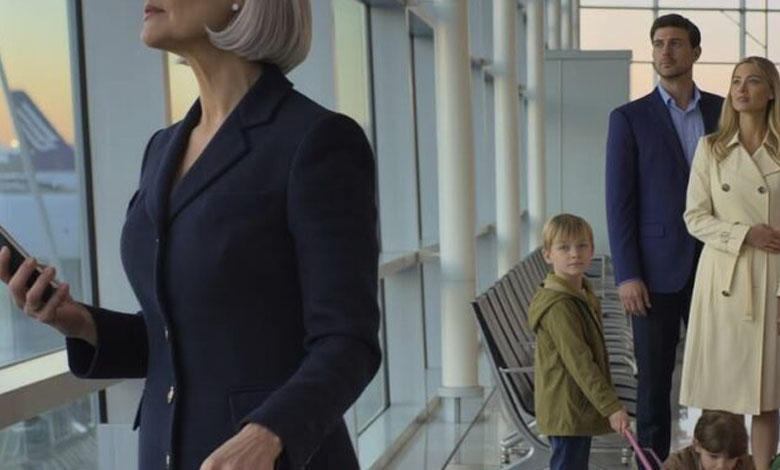
For three stunned heartbeats I just stood there in the middle of Chicago O’Hare, surrounded by rolling suitcases, stale coffee, and strangers who suddenly knew more about my family than they should. Then I did what everyone expected the “nice” grandmother to do.
I silently nodded.
I turned around.
And I walked away like I was nothing more than an Uber driver who’d dropped them off at the curb.
But a minute later, when I was far enough from their gate that I couldn’t hear Jessica’s cheerful voice or my grandchildren’s nervous giggles, I did something no one in that terminal saw coming. It wasn’t dramatic in the movie sense—no shouting, no thrown drinks, no scene for security to break up.
It was quieter than that.
Colder than that.
And it was the one decision that would make them scream and beg me to undo it… not just for that trip, but for the rest of their lives.
Before we continue, I just want to say thank you for taking the time to hear my story. If you’re comfortable, let me know where you’re listening from and what time it is where you are. I’ve spent my whole life hearing heart monitors and hospital pagers; these days, I like picturing people in different cities, in different time zones, reading this on their phones over coffee or in bed.
Now, let me tell you my story.
The alarm went off at 3:30 a.m., but I was already awake.
I’d been awake for hours, too excited to sleep, mentally running through the checklist for our family trip to Hawaii. Ten days. Maui. The whole family together. My son, my daughter-in-law, my grandchildren. The kind of multigenerational vacation you see in airline commercials, except this one was real and it was mine.
I’m Dr. Margaret Hayes, sixty-seven years old, a retired cardiologist who spent forty years saving lives at Chicago Memorial Hospital on the Near South Side. I built a successful private practice in the Gold Coast, pioneered several minimally invasive cardiac procedures, published over fifty research papers, testified as an expert witness in more malpractice cases than I care to remember—and yes, I made quite a bit of money doing it.
But none of that mattered as much to me as this trip.
This wasn’t about my career or my bank account. This was about family. About my son Kevin. His wife Jessica. And my two precious grandchildren, Tyler and Emma.
I’d been planning this vacation for six months from my brownstone in Lincoln Park, laptop open on the kitchen island while Lake Michigan winds rattled the windows. I cross‑checked school calendars and Chicago weather, pored over TripAdvisor reviews, argued with myself about oceanfront versus partial ocean view, and talked to three different concierges on Maui before I was satisfied.
In the end, I booked us into an upscale resort in Wailea—oceanfront suites, on-site kids’ club, lazy river, the kind of place where families from all over the United States fly in with matching Lululemon luggage and sunhats that say “Mama” in cursive. I arranged luau reservations, snorkeling trips, a helicopter tour of the island, and a special day trip along the Road to Hana.
Ten days of memory-making with the people I loved most.
Total cost: forty-seven thousand dollars.
Worth every penny, I told myself, to see my grandchildren’s faces when they saw the Pacific Ocean for the first time. Worth every airline mile, every early-morning call with a travel concierge sitting somewhere in a glass office in Honolulu or Los Angeles.
I didn’t just throw money at a travel agent and call it a day. I curated this trip.
Tyler, eight years old, is obsessed with sea turtles. I booked a special marine biology excursion run by a local nonprofit where kids can learn about honu conservation and watch volunteers tag turtles.
Emma, six years old, loves princesses and dolphins. I found a dolphin encounter program at a reputable facility, read every review to make sure it wasn’t exploitative, and reserved dinner at a restaurant where she could dress up in a little blue dress and feel like she’d stepped into her own fairy tale. I even ordered a tiny plastic tiara off Amazon, shipped it to my house in Chicago, and packed it in my carry-on.
Everything perfect. Everything planned with love.
I showered, put on comfortable travel clothes—black leggings, a soft Northwestern sweatshirt, the running shoes I use for my four-mile jogs along the lakefront—and double-checked my suitcase one more time. Passport. Wallet. Printed confirmations even though everything is in an app now. My cardiology brain doesn’t trust a single point of failure.
At 5:00 a.m., a black sedan from a local car service pulled up in front of my brownstone. The driver loaded my suitcase into the trunk while I locked the front door of my house that I’d bought years ago when the hospital bonuses were coming in strong and the Chicago housing market was still forgiving.
We drove down Lake Shore Drive toward O’Hare International Airport, the lights of the Chicago skyline shimmering over Lake Michigan, the Willis Tower and John Hancock Building just silhouettes against a still-dark sky. Even after all these years, that drive still makes me feel lucky to have lived my whole life in this city.
We were all meeting at O’Hare at 6:00 a.m. for our 8:15 flight to Honolulu, then on to Maui. Hawaiian Airlines. I’d upgraded all five tickets to business class—lie-flat seats, real silverware, little orchids on the trays. I wanted this to be special.
I arrived at the airport at 5:45, rolling my suitcase through Terminal 3, past the Starbucks with the line already snaking out, past families in Disney sweatshirts headed to Orlando, past bleary-eyed business travelers clutching briefcases and cold brew.
I scanned the crowds near the Hawaiian Airlines check-in counter and spotted them.
Kevin, my thirty-eight-year-old son, tall with his father’s broad shoulders, dark hair starting to show a few gray strands at the temples. The boy I raised alone after my husband, Thomas, died of a heart attack when Kevin was just ten years old.
Jessica, his wife of ten years, thirty-five, blonde, always immaculately dressed even at dawn. Before the kids were born, she worked in marketing for a tech startup downtown. Now she stayed home full-time, managing PTA committees and Instagram stories.
Tyler and Emma were bouncing despite the early hour, each wearing the new outfits I’d bought them specifically for this trip: Tyler in a T-shirt with cartoon sea turtles, Emma in a pink sundress with little white hibiscus flowers printed all over it. They had little matching kids’ carry-ons, also bought by me, with airplane stickers already on the sides.
And someone else.
An older woman stood beside them, an overnight suitcase at her feet. I recognized her instantly from birthday parties and school events.
Linda. Sixty-three. Jessica’s mother.
She wore a comfortable travel outfit—elastic-waist pants, a floral blouse, a light cardigan—and a look that hovered somewhere between excitement and mild discomfort. Her hair, more gray now than blonde, was pulled back into a neat bun. Her suitcase had a Maui luggage tag.
A small warning bell went off in my mind.
Why was Linda here?
She wasn’t part of this trip. This was my family vacation, my gift to my son and his family. I’d paid for everything—every ticket, every room, every activity—with money I had earned over four decades of fourteen-hour shifts, middle-of-the-night codes, and early-morning rounds.
I approached, forcing a smile to my face.
“Good morning,” I called out cheerfully. “Everyone ready for paradise?”
Tyler and Emma glanced up at me but didn’t run over like they usually did. Tyler gave me a quick, tight smile. Emma clutched the handle of her suitcase.
Jessica turned toward me, her expression oddly flat.
Not excited. Not warm.
Cold.
“Margaret, there’s been a change of plans,” she said.
I stopped, my hand still wrapped around the suitcase handle, fingers suddenly numb.
“A change of plans?” I repeated. I heard my own voice from far away, like it was coming through a hospital intercom.
Jessica sighed as if I were already inconveniencing her.
“We gave your ticket to my mother,” she said, tilting her head toward Linda. “The kids love her more and she deserves a vacation. You understand, right?”
For a heartbeat, I thought I must have misheard her. Maybe it was the noise. Maybe it was the flight announcements echoing off the high ceiling. Maybe she’d said something about the rental car, the room type, anything else.
“You what?” I asked.
Jessica’s tone stayed casual, almost bored, like she was rearranging dinner reservations and not rewriting a forty-seven-thousand-dollar family trip I had planned down to the last snorkel fin.
“We changed your reservation,” she said. “Linda’s going instead. You can just go home.” She smiled like she was being reasonable, generous even. “The grandkids love her more. They’re closer to her. It makes sense for her to be the one on the beach with them.”
The sentence landed harder than any blunt force trauma I’d ever seen on a CT scan.
I turned to Kevin.
For thirty-eight years, I’ve watched emotion move across my son’s face the way I watched EKG waves march across monitors. Fear, joy, teenage arrogance, first-love stupidity, the quiet pride when he opened his Northwestern acceptance letter. I know every version of that face.
The version looking back at me at O’Hare was one I’d never seen before.
Avoidance.
Cowardice.
“Kevin,” I said. “Tell me this is a joke.”
He shifted his weight, staring somewhere over my shoulder at a United sign like he wanted to disappear into it.
“Mom, it makes sense,” he mumbled. “Linda rarely gets to spend time with the kids. You see them all the time. It’s just one trip.”
Just one trip.
The trip I’d planned for six months. The trip I’d paid forty-seven thousand dollars for. The trip I’d built in my head as the big Hayes family memory, the one my grandchildren would talk about when I was gone.
“Just one trip,” I repeated.
Jessica crossed her arms over her designer athleisure jacket.
“We already changed the reservation with the airline,” she said. “Linda’s seat is confirmed. Your ticket is canceled. Look, it’s not a big deal, Margaret. Stop being dramatic. You’re too old for Hawaii anyway. All that sun and activity, you’d just slow us down.”
Too old.
I am sixty-seven years old. I have cracked open chests at three in the morning and put beating hearts back together while residents half my age nearly fainted. I run four miles three times a week on the lakefront trail, dodging cyclists and college kids. I can walk the stairs to the top of the museum campus without stopping.
But to my daughter-in-law, I was “too old” to sit by a pool and watch my grandchildren play.
I looked at Tyler and Emma, hoping—praying—for some flicker of confusion, some crease of a frown that said this felt wrong to them too.
They stared at the floor.
Their little carry-ons stood at attention beside them like loyal soldiers. Tyler chewed his lip. Emma twisted the sleeve of her sundress. Someone had clearly told them not to say anything.
My grandchildren, who I’d pictured splashing next to me in the Pacific, wouldn’t look at me.
Around us, the hum of O’Hare shifted. A couple at the next check-in kiosk slowed their typing. A TSA agent looked our way, then quickly away. A teenager in a Chicago Bulls hoodie unabashedly watched the show.
“It’s not a big deal,” Jessica repeated, flicking invisible lint from her clothing. “We’ll send you pictures from the trip.”
She actually said that.
We’ll send you pictures from the trip you paid for, the trip you’re being cut out of like a tumor.
I stood very still and felt my heart rate climb. Not into the danger zone; I know those numbers. Just high enough to remind me I was angry.
Forty years as a cardiologist teaches you to separate panic from decision. In code situations, there is always a moment—a single breath—where everything slows down and you either freeze or move.
I moved.
I looked at Kevin.
At the boy I’d sat with in emergency rooms. At the teenager whose college tuition I’d paid. At the man whose mortgage and kids’ tuition I was supplementing every month.
He stared at a scuff on the airport floor.
“Kevin,” I said quietly. “Is this really what you want to do?”
It would have been so easy for him to fix it. One sentence: Mom paid, Mom comes. One move: walk over to the counter, tell the airline there’d been a mistake, reinstate my ticket.
“Yes,” he said finally. “It’s just one trip, Mom.”
There it was.
Not Jessica’s cruelty.
Kevin’s choice.
I felt something very old and very deep inside me crack, the way old plaster cracks in a house when you finally slam the door too hard.
I took in all of them in one long, steady look.
Kevin, who couldn’t meet my eyes.
Jessica, impatient and dismissive, already mentally on the beach.
Linda, clutching her boarding pass like a golden ticket, uncomfortable but not enough to walk away.
Tyler and Emma, learning this is how you treat someone who loves you.
“I understand,” I said.
My voice came out smooth and clinical, the voice I used to deliver bad news in family conference rooms at Chicago Memorial.